Creating Backyard Play Areas is one of the most exciting ways to transform an ordinary outdoor space into a place filled with adventure, creativity, movement, and memorable childhood experiences. Instead of relying on a single plastic playset sitting in the middle of the lawn, modern backyard play spaces can combine landscaping, natural materials, climbing challenges, sensory activities, and imaginative features that make the entire garden feel like a destination.
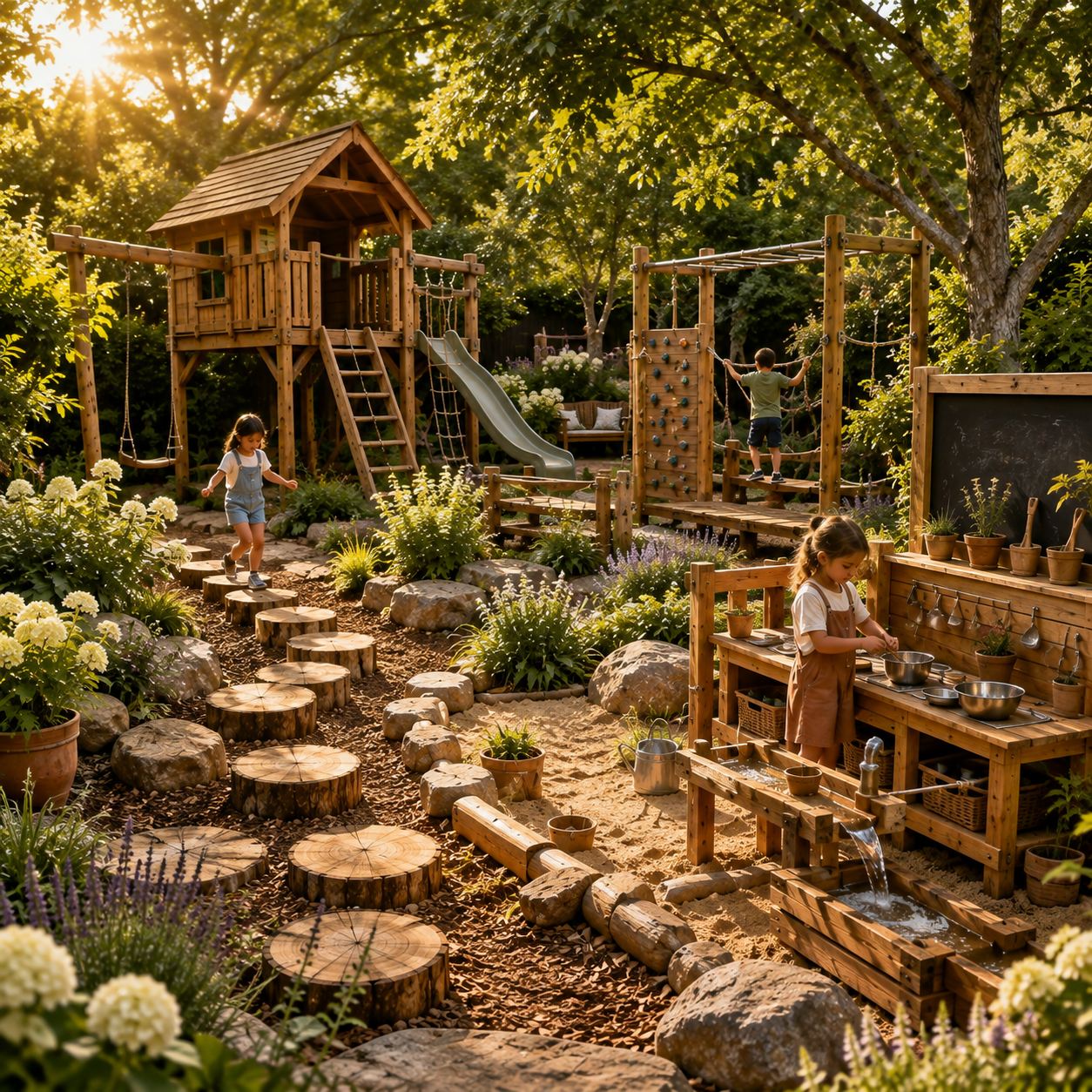
The most successful backyard playground does not necessarily need to be enormous or expensive. Thoughtful planning often matters far more than size. A compact corner can become a miniature adventure garden, while a larger backyard can be divided into several activity zones that encourage children to explore different kinds of play throughout the day. 🌿
For families looking for something more beautiful and integrated with the landscape, the best designs also avoid making the yard feel like a commercial playground. Natural timber, stepping stones, sand, plants, rope, gravel, and subtle play structures can create an environment that looks attractive from the house while still offering children plenty to discover.
Among the many possibilities, three concepts stand out because they offer very different experiences: a natural adventure playground, an active climbing zone, and a creative sensory play garden.
Quick Comparison of the Best 3 Backyard Play Areas
Before designing the space, it helps to compare the three approaches and understand what each one contributes to the backyard.
| Backyard Play Area Idea | Best For | Main Features | Space Needed | Maintenance |
|---|---|---|---|---|
| 🥇 Natural Adventure Playground | Imaginative outdoor exploration | Logs, stepping stones, sand, plants, playhouse | Medium to large | Low to moderate |
| 🥈 Climbing and Activity Zone | Energetic and active play | Climbing wall, ropes, monkey bars, swings | Medium | Moderate |
| 🥉 Creative Sensory Play Garden | Creative and exploratory play | Mud kitchen, water table, sand, sensory plants | Small to medium | Moderate |
There is no requirement to choose only one concept. In a larger yard, elements from all three can be combined. A climbing structure might sit beside a natural stepping-log trail, for example, while a small sensory corner occupies a quieter section beneath a tree.
The important part is creating clear zones without making the backyard feel crowded.
🥇 Best 1 Natural Adventure Backyard Play Areas
A natural adventure playground earns the number-one position because it can turn the backyard itself into the play equipment.
Instead of filling the garden with brightly colored plastic structures, this approach uses materials that naturally belong outdoors. Timber logs, tree stumps, rocks, sand, wooden platforms, rope, shrubs, and winding paths become opportunities for climbing, balancing, hiding, building, and imaginative play.
The result can feel somewhere between a secret garden and a miniature woodland playground. 🌳
This concept works particularly well for homeowners who care about the appearance of their landscaping. When designed carefully, the play area can blend almost seamlessly into planting beds and existing trees.
Why Natural Backyard Play Areas Feel More Adventurous
Children do not always need equipment that tells them exactly how it should be used.
A slide is primarily designed for sliding. A swing is primarily designed for swinging. A simple fallen log, however, can become a balance beam, bridge, pirate ship, boundary, seat, obstacle, or part of an imaginary fort.
That flexibility is one of the greatest strengths of natural play.
Create several layers of exploration rather than one central structure. A winding path could lead past stepping stumps toward a small timber platform. Large stones might form another route across the landscape. A sand area could occupy one corner while a simple wooden hideout sits partially surrounded by ornamental grasses.
Children can then decide how they want to move through the environment.
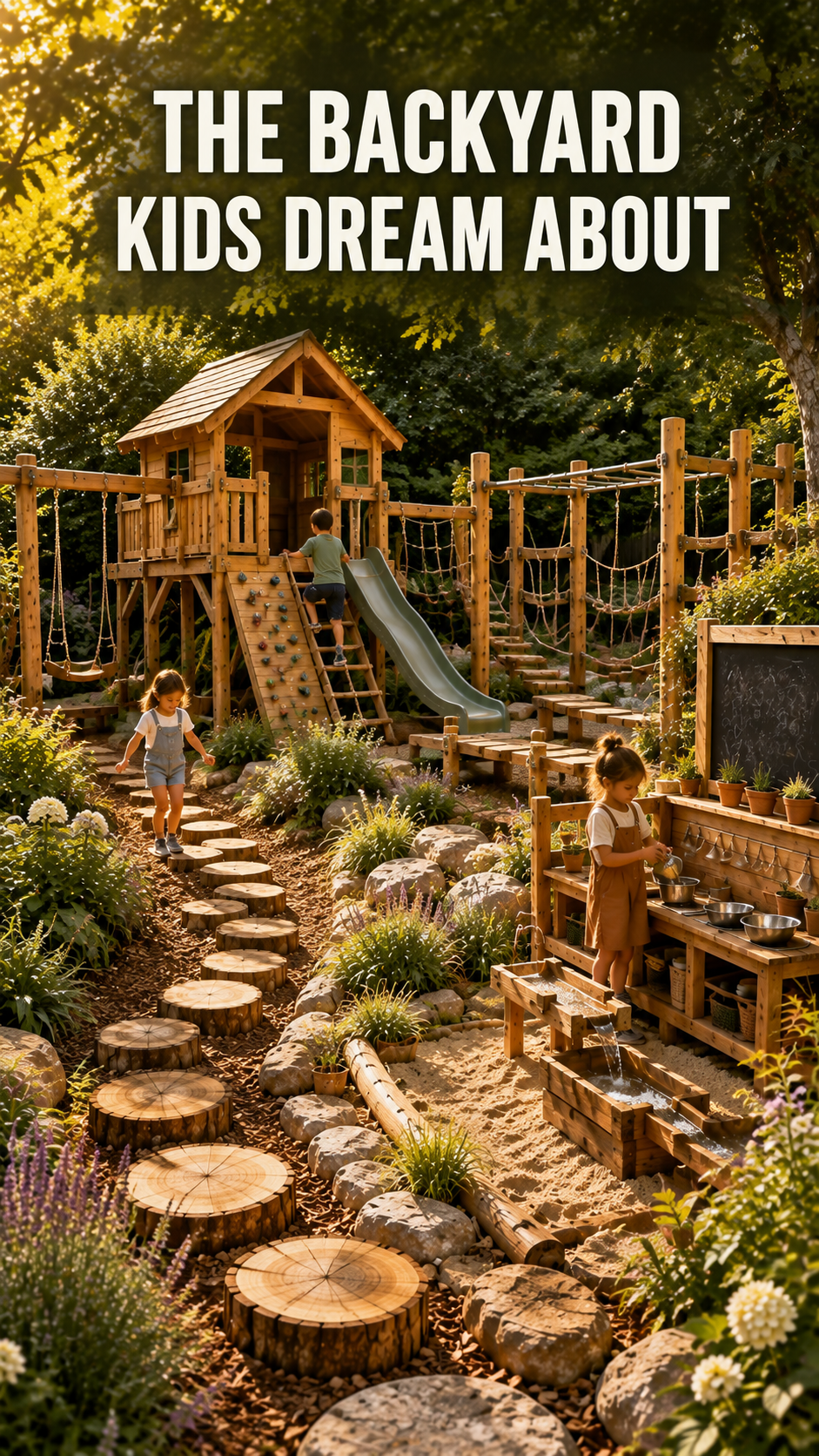
Create a Stepping Log Adventure Trail
One of the easiest features to incorporate is a sequence of timber stepping rounds or low stumps.
Arrange them at manageable distances so children can move from one to another. Instead of creating a perfectly straight line, let the route curve through the play area.
Different heights can make the course more interesting, provided the dimensions and surrounding surfaces remain appropriate for the children’s ages and abilities.
Natural logs can also become low balance beams. Combining horizontal logs with stepping rounds immediately makes the area more dynamic without requiring a complicated playground structure.
Surrounding the route with bark mulch or another suitable impact-absorbing surface can visually reinforce the woodland atmosphere.
Add a Small Wooden Playhouse or Adventure Hut
Every great adventure garden benefits from a destination.
A small wooden playhouse can become that focal point. Rather than choosing something that resembles a miniature plastic house, consider a simple timber hut with an understated design.
It might feature a small porch, open window, chalkboard panel, bench, or little counter.
The structure can become almost anything through imaginative play: a woodland café one day, an explorer’s cabin the next, and a secret headquarters later in the week. 🏡
A playhouse positioned near shrubs or beneath the canopy of a mature tree can feel especially magical.
Plants should never block adult visibility completely, however. The goal is to create the feeling of a secret garden while preserving appropriate supervision.
Use Sand as Part of the Landscape
A sandbox does not need to look like a separate object dropped into the yard.
Consider integrating sand directly into the landscape using timber edging, natural stone borders, or a recessed section beside the playhouse.
Add simple digging tools, buckets, molds, wooden scoops, and containers. Children can build roads, castles, landscapes, tunnels, and imaginary construction sites.
For a more refined backyard, a fitted cover can help keep the sand area tidy when it is not being used.
Nearby bench seating can also serve two purposes: children gain another surface for play, while adults have somewhere comfortable to supervise.
Create Secret Paths Through Child Friendly Planting
Plants can dramatically change the atmosphere of Backyard Play Areas.
Rather than surrounding the playground with an empty lawn, use planting to create little pathways and boundaries.
Soft ornamental grasses, herbs, groundcovers, and sturdy shrubs can help define zones without requiring fences everywhere. A curving path between planting beds can make even a relatively small backyard seem more adventurous.
Fragrant plants can add another layer of interest. Depending on local growing conditions, herbs such as rosemary, mint in controlled containers, or other suitable aromatic plants can make a pathway more sensory.
Always research plant suitability carefully before including vegetation in areas intended for children.
Important Note: Safety should determine the final dimensions, materials, surfacing, placement, and construction of every backyard play feature. Avoid toxic plants, sharp edges, unstable logs, entrapment hazards, unsafe ropes, and structures that are inappropriate for the child’s age. Elevated or climbing equipment should be securely built and paired with appropriate impact-absorbing surfacing and supervision.
Make the Natural Playground Beautiful From the House
A common concern is that children’s equipment will dominate the garden visually.
Natural play design solves much of this problem.
Use a restrained material palette throughout the space. For example, repeat the same warm timber on the playhouse, edging, stepping logs, and benches.
Then connect those materials to the rest of the garden using stone paths, mulch, gravel, or planting.
Muted colors such as natural oak, warm brown, sage green, sandy beige, and charcoal can make the play area feel like an intentional part of the landscape rather than a temporary collection of toys.
This is particularly useful when the backyard is visible through large windows or directly connected to an outdoor dining and entertaining area.
🥈 Best 2 Climbing and Activity Backyard Play Areas
Some children want to climb everything.
For them, the second concept is difficult to beat.
A climbing and activity zone transforms part of the backyard into a compact movement-focused playground with features such as climbing walls, monkey bars, ropes, swings, ladders, balance obstacles, and platforms.
The key is not simply adding as much equipment as possible. A better approach is to design a sequence of challenges.
Children should feel as though they are progressing through an obstacle course rather than moving between unrelated pieces of equipment. 🧗
Start With One Strong Central Structure
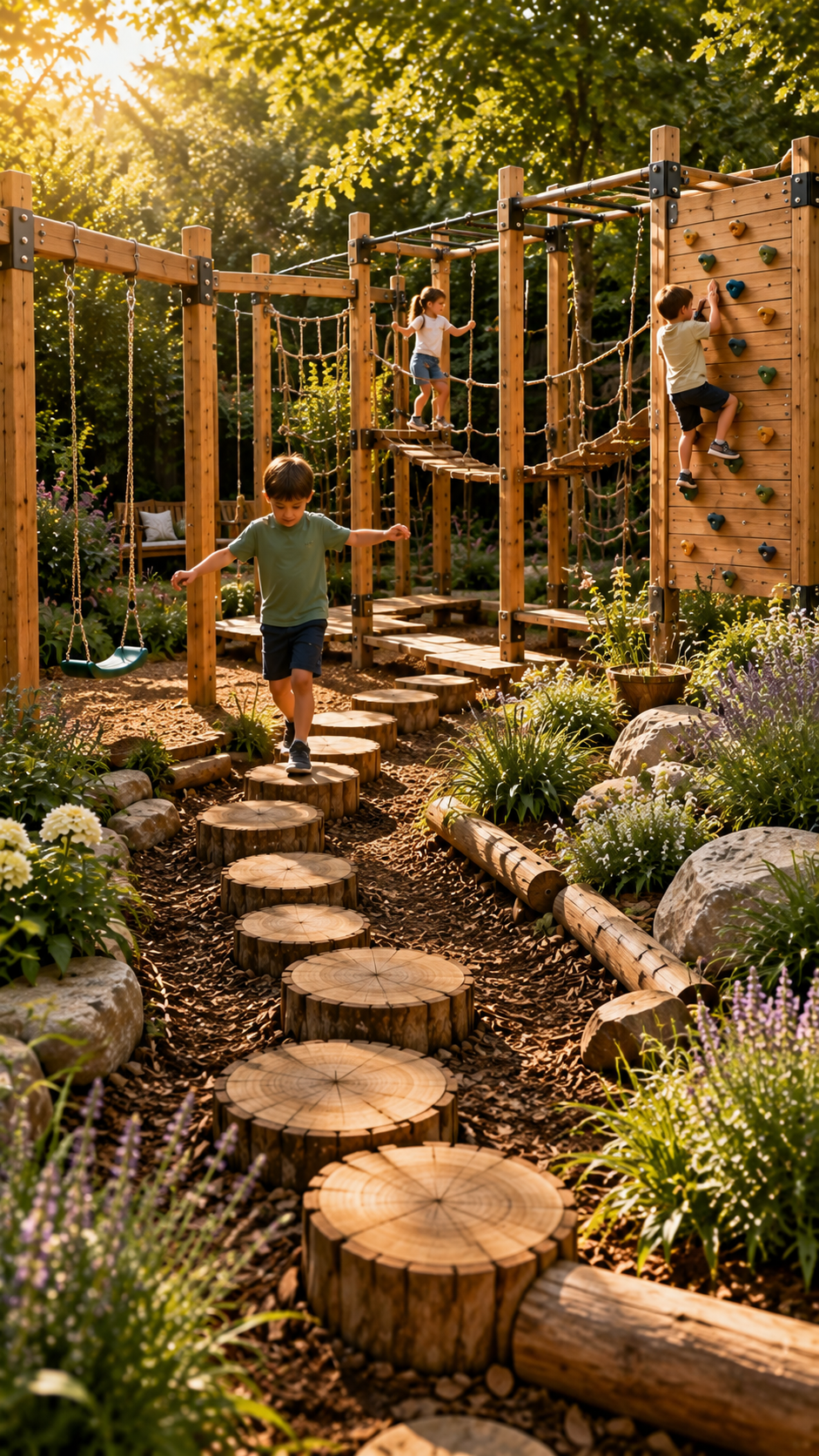
Instead of scattering multiple structures around the lawn, begin with one carefully planned central frame.
Timber works beautifully for this purpose because it can blend with many garden styles.
A sturdy wooden structure might combine a raised platform, climbing wall, ladder, monkey bars, and swing beam within one cohesive footprint.
This approach can be especially useful in medium-sized backyards where every square foot matters.
The structure can also grow with the family more easily than a single-purpose toddler playset. Some components can be changed or adapted as children become more confident.
Add a Backyard Climbing Wall
A climbing wall can make a dramatic feature without consuming a huge amount of ground space.
The wall could be incorporated into the side of a wooden tower or built as part of a larger activity structure.
For visual appeal, consider a natural timber background rather than a brightly colored commercial-style panel. Climbing holds can still introduce subtle color without overwhelming the garden.
The layout of the holds should correspond to the intended age and skill level.
Younger children generally benefit from simpler, lower routes, while older children may enjoy more varied movement.
The landing area deserves as much planning as the wall itself. Suitable protective surfacing and careful construction are essential.
Incorporate Monkey Bars and Overhead Challenges
Monkey bars introduce a completely different kind of movement.
They encourage children to travel across the structure using their upper body rather than simply climbing upward.
An overhead ladder can connect two platforms or function as a standalone challenge.
Rope features can add variety too, but they require particularly careful design to avoid dangerous configurations.
For a visually cohesive play zone, keep the structural frame relatively simple. Heavy timber posts combined with black or dark metal hardware can create a contemporary appearance that fits surprisingly well in a landscaped backyard.
Include Swings Without Letting Them Dominate
Swings remain one of the classic elements of Backyard Play Areas for good reason.
The repeated motion offers a different experience from climbing and obstacle play, and children often return to swings even after other playground features lose their novelty.
However, swings require adequate clear space.
This makes placement especially important.
Rather than squeezing them between other activity stations, position the swing section along one side of the play structure where the movement path remains unobstructed.
A simple timber frame can visually connect the swings with the climbing equipment.
Depending on the family, the design might incorporate different seat styles appropriate to the intended users.
Build a Mini Backyard Obstacle Course
The most exciting activity zones encourage movement from one challenge directly into another.
Imagine a child starting at a low balance beam, stepping across timber rounds, climbing a short wall, crossing monkey bars, descending a ladder, and finishing at another balancing challenge.
Suddenly the backyard becomes a mini obstacle course. 🏃
The course does not have to be enormous.
Compact features can be surprisingly effective when arranged intelligently.
Low balance elements are particularly useful because they create challenges without relying exclusively on height. Timber beams, stepping rounds, stable platforms, and carefully designed obstacles can make the course interesting while preserving a more natural appearance.
Use Landscaping to Soften the Activity Zone
Climbing structures can become visually heavy.
Landscaping helps prevent them from overwhelming the yard.
Instead of leaving the structure surrounded entirely by lawn, frame the broader area with planting beds while preserving required safety clearances.
Ornamental grasses can soften timber posts. Trees positioned at appropriate distances can provide valuable shade. Groundcover and shrubs can connect the playground visually with the rest of the landscape.
A pathway leading from the house toward the activity area also makes the playground feel intentional.
The objective is to make the structure appear designed with the garden rather than installed after the garden was finished.
Plan for Shade and Comfortable Supervision
Backyard play can last much longer when children are not exposed to intense direct sun throughout the day.
Existing trees can provide excellent shade if they are healthy and appropriately positioned.
Where natural shade is unavailable, carefully placed shade structures may help.
Adult seating is equally valuable.
A bench near the activity zone creates a comfortable supervision point without requiring adults to stand beside the playground continuously.
Consider positioning the bench where multiple activity areas are visible simultaneously.
That becomes particularly useful if the backyard combines a climbing structure with another zone such as a sandbox or sensory garden.
🥉 Best 3 Creative Sensory Backyard Play Areas
Not every memorable playground needs tall climbing structures.
The third idea takes a quieter but equally engaging approach.
A creative sensory play garden encourages children to touch, pour, build, dig, mix, smell, observe, and experiment.
This style of Backyard Play Areas can be particularly useful for compact gardens because many activities fit into small footprints.
A sensory area might combine a mud kitchen, water-play station, sandbox, chalk wall, musical features, textured pathway, and child-friendly planting.
Instead of one dominant play structure, the environment contains multiple small invitations to explore. 🌼
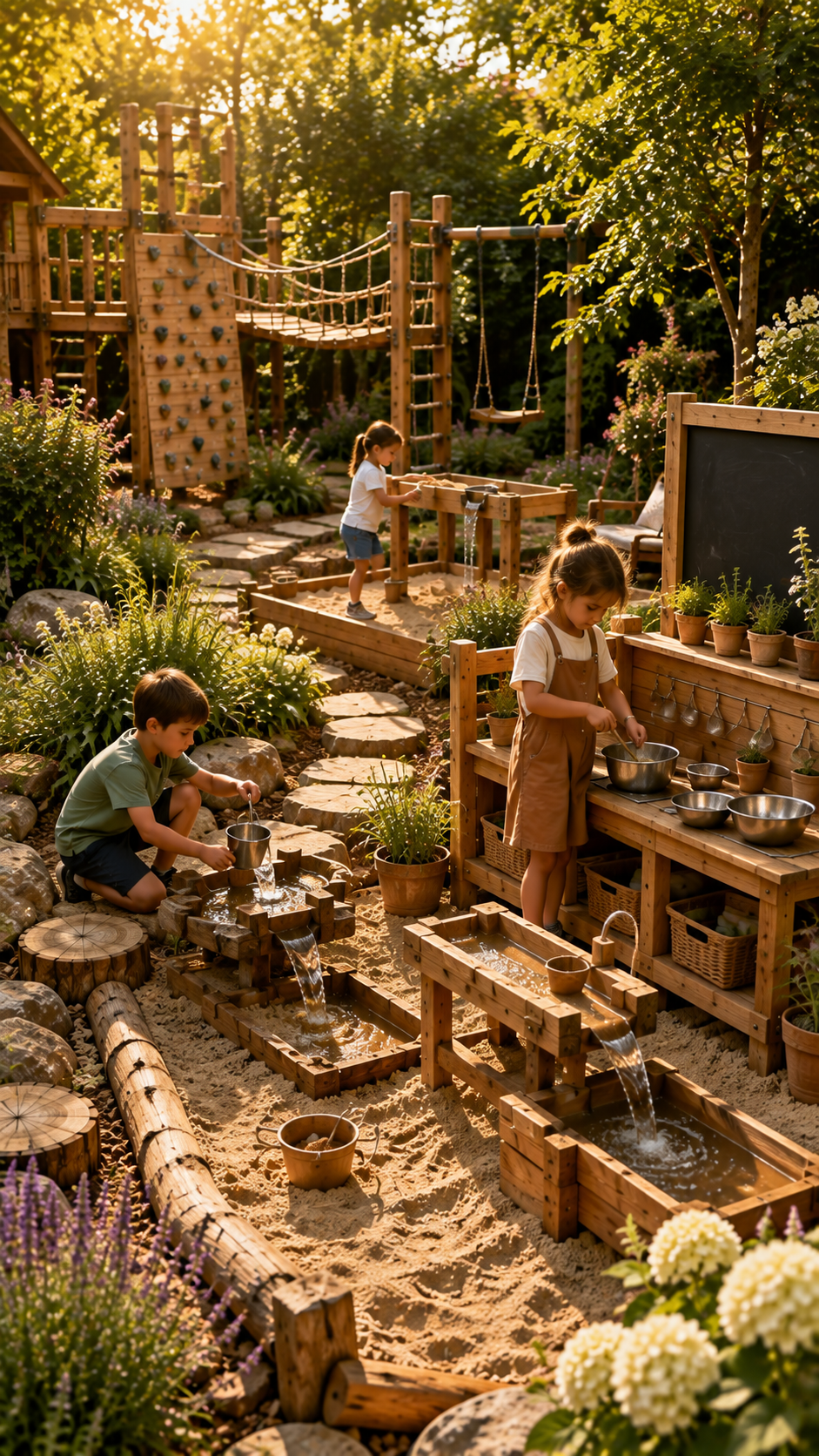
Build a Charming Outdoor Mud Kitchen
A mud kitchen can become the centerpiece of the sensory garden.
At its simplest, it needs a durable outdoor counter, bowls or basins, storage, and a collection of child-appropriate utensils.
A timber construction gives the area a warm natural appearance.
Old pots, wooden spoons, measuring cups, small containers, and mixing bowls can inspire countless imaginary recipes.
Children can combine soil, leaves, petals from appropriate sources, sand, and water to create their own outdoor concoctions.
The mud kitchen becomes even more engaging when positioned near other sensory elements.
Place a sandbox nearby, for instance, and suddenly children have another ingredient for their imaginary café.
Create a Water Play Station
Water can transform a simple sensory area.
Rather than relying on an elaborate permanent installation, a controlled water-play station can use channels, funnels, containers, pouring cups, and basins.
Children can explore how water moves from one level to another.
A simple timber water wall with securely attached tubes and funnels can turn pouring into an experiment.
The experience is playful but also naturally introduces ideas such as flow, volume, gravity, and cause and effect. 💧
Drainage is an important design consideration.
Position wet-play features where spilled water will not create persistent slippery or muddy conditions unless mud play is intentionally part of the design.
Add a Sensory Planting Garden
Plants can become play features themselves.
A sensory garden can contain child-appropriate plants selected for interesting textures, fragrances, colors, or movement.
Some plants rustle dramatically when touched by the wind. Others release fragrance when leaves are gently handled. Flowers can introduce seasonal changes and encourage children to notice pollinators from a respectful distance.
The garden can also teach children that outdoor spaces change throughout the year.
New shoots appear. Flowers open. Leaves change. Seeds form.
Rather than viewing the backyard as static playground equipment, children begin interacting with a living environment.
Plant selection should always reflect local climate, maintenance requirements, and safety.
Make a Textured Barefoot Path
One of the most visually interesting sensory features is a short textured path.
Separate the pathway into sections containing different suitable materials.
Smooth stones, timber rounds, fine gravel, sand, and other safe textures can create distinct sensations underfoot.
The pathway might curve between planting beds rather than running in a straight line.
That small design choice makes it feel more like a journey.
A barefoot path can also connect several activity stations. Children might begin at the mud kitchen, follow the textured route through the plants, and arrive at the water-play station.
This creates continuity across the sensory garden.
Add an Outdoor Art Station
Creative play deserves a place outdoors too. 🎨
A weather-resistant chalkboard can turn a fence or freestanding timber panel into an art station.
Provide an accessible shelf or storage box for chalk and other suitable outdoor creative materials.
The artwork can constantly change without permanently altering the backyard.
For a more flexible setup, an outdoor easel can be brought out during creative sessions and stored afterward.
Positioning the art area near a patio can make cleanup and supervision easier.
It also gives children a creative activity while adults use adjacent outdoor living spaces.
Include Loose Parts for Open Ended Play
One of the easiest ways to keep a sensory garden interesting is to avoid making every activity permanent.
Introduce loose materials that can be moved and rearranged.
Suitable items might include wooden blocks, buckets, scoops, large natural pieces chosen with safety in mind, containers, and simple construction materials.
Children can decide what those objects become.
A collection of blocks might become a miniature city today and an obstacle route tomorrow.
That adaptability can keep the backyard interesting far longer than toys that have only one obvious function.
How to Combine All Best 3 Backyard Play Areas
For families with enough space, the most exciting option may be combining all three concepts.
The natural adventure garden can form the foundation.
Use timber, rocks, planting, paths, and natural surfaces to establish a cohesive landscape. Then place the more structured climbing zone in the most appropriate open section.
The sensory garden can occupy a quieter corner closer to the house or patio.
This creates three different energy levels.
The climbing zone provides high-energy movement. The natural adventure section supports exploration and imaginative games. The sensory area creates opportunities for slower creative activities.
Children can move naturally between them depending on their mood.
Create Zones Instead of One Giant Playground
Zoning is one of the most useful strategies when planning Backyard Play Areas.
A backyard divided into smaller experiences often feels larger than one containing a single oversized structure.
For example, a medium-sized garden could include a climbing frame at the rear, a stepping-log path along one side, and a mud kitchen closer to the patio.
Planting beds and pathways can visually separate each area without creating hard boundaries.
This also allows the garden to retain its identity as an outdoor living space rather than becoming exclusively a playground.
Choose Materials That Connect Every Area
Consistency is what turns several playground ideas into one attractive design.
Repeat materials.
If the climbing structure uses natural timber, use similar timber for the mud kitchen and sandbox border.
If the main garden contains limestone or gravel paths, introduce those materials around the play zones where appropriate.
Choose a limited palette instead of filling the yard with unrelated colors.
Natural wood, warm beige, muted green, charcoal, and earthy stone tones work particularly well in contemporary outdoor spaces.
Bright toys can still provide temporary pops of color without determining the overall appearance of the landscape.
Think About How the Backyard Will Change
Children grow quickly, which makes adaptability an important consideration.
A sandbox that is loved today may eventually receive less attention. A low toddler climbing feature may become too easy.
Designing flexible zones makes future changes easier.
A sandbox can eventually become a planting bed. A playhouse can become a garden retreat or storage space. A sensory table can become a potting station.
A sturdy timber platform might remain useful even when the original play equipment attached to it changes.
Planning for these transitions can make the initial investment feel much more worthwhile.
Backyard Play Areas for Small Yards
A small backyard does not automatically require a boring play area.
The secret is to use vertical and multifunctional features.
Instead of installing several freestanding pieces, combine activities into one compact structure. A small playhouse wall could support a chalkboard on one side and an activity panel on another.
A raised platform might incorporate storage beneath it.
A narrow side garden can contain a sensory path.
A fence can support a carefully designed art or water-play panel.
Even a corner measuring only a few meters across can become a miniature play garden when every feature has a clear purpose.
Avoid filling every available space.
Children also need open floor or ground area where they can invent their own games.
Sometimes an empty patch of suitable ground is just as valuable as another piece of equipment.
Backyard Play Areas for Large Gardens
Large yards create different opportunities.
Instead of concentrating everything in one location, create a journey through the garden.
A pathway from the house might first reach a sensory station, continue toward a natural playhouse, pass stepping logs, and finally arrive at the climbing zone.
This creates a sense of discovery.
Trees, shrubs, and ornamental grasses can help divide the garden into smaller outdoor rooms.
From one location, children may not immediately see everything waiting around the next corner.
That sense of mystery can make a backyard feel much larger than its actual dimensions.
Large gardens can also preserve generous open areas for running, ball games, picnics, or temporary activities.
The goal should not be to fill the entire landscape with equipment.
How to Make Backyard Play Areas Look Stylish
A beautiful children’s garden does not need to sacrifice fun.
Start by treating the play area as part of the landscape design.
Choose materials that complement the home.
A contemporary house might pair well with simple timber structures, black hardware, neutral gravel, and structured planting. A cottage-style garden might suit a rustic playhouse surrounded by flowers, herbs, and winding stepping-stone paths.
Avoid excessive visual clutter.
Provide storage for loose toys, buckets, balls, chalk, and outdoor equipment.
Built-in storage beneath benches or inside a playhouse can make a dramatic difference.
When playtime ends, the major landscape features remain visible while the smaller objects disappear.
Lighting can add another sophisticated layer, although play equipment itself should not encourage unsupervised use after dark. Subtle landscape lighting along nearby paths and planting can make the overall backyard beautiful in the evening.
Which of the Best 3 Backyard Play Areas Is Right for Your Family
The ideal choice depends less on trends and more on how children actually like to play.
For children who constantly invent stories, collect natural objects, build forts, and explore the garden, the 🥇 Natural Adventure Playground is likely to provide the greatest variety.
For energetic children who love climbing, swinging, balancing, and physical challenges, the 🥈 Climbing and Activity Zone offers more opportunities for movement.
For children who enjoy making, pouring, digging, drawing, gardening, and experimenting, the 🥉 Creative Sensory Play Garden can turn even a relatively small backyard into a fascinating environment.
Many families will discover that the strongest design combines pieces of all three.
A climbing structure does not prevent the garden from feeling natural. A sensory station does not require an entirely separate yard. A few stepping logs can connect everything together.
The best Backyard Play Areas are not collections of equipment. They are environments designed around experiences.
Final Thoughts on Creating Unforgettable Backyard Play Areas
The most memorable Backyard Play Areas give children reasons to keep discovering something new.
🥇 A Natural Adventure Playground can transform logs, stones, sand, timber, plants, and pathways into an imaginative landscape where the backyard itself becomes part of the game.
🥈 A Climbing and Activity Zone can create an exciting destination for movement with carefully planned climbing walls, balance challenges, swings, platforms, and overhead activities.
🥉 A Creative Sensory Play Garden can turn a quieter corner into a world of mud kitchens, water exploration, gardening, textures, art, and open-ended creativity.
The strongest backyard may borrow from every idea.
Picture a natural timber climbing structure nestled against soft landscaping. A winding trail of stepping logs leads away from it toward a small woodland-style playhouse. Beyond the playhouse sits a sand area, while a quieter corner contains a charming mud kitchen and sensory planting garden.
Instead of looking like playground equipment scattered across a lawn, everything becomes part of one cohesive outdoor environment. 🌿
That is what can make a backyard play space truly special.
It remains beautiful enough to complement the home while giving children a place where climbing, building, experimenting, imagining, and exploring can happen only a few steps from the back door.
And when a backyard offers that much possibility, going outside no longer feels like something children are told to do. It becomes the place they genuinely want to be.
Related posts:

Best Outdoor Living Spaces Ideas That Instantly Make Your Backyard Feel Like a Luxury Retreat
Best Outdoor Bar Top Ideas That Instantly Transform Your Backyard Into a Luxury Entertaining Space
Best Fence Mural Ideas Backyards That Make Every Outdoor Space Look Expensive
Outdoor Fire Pit Seating Ideas for Small Backyard That Will Blow Your Mind
Backyard Goals Unlock These Genius Large Backyard Layout Ideas With Fire Pit and Seating