
Minimalist Shelf Decor is one of the simplest ways to make an ordinary shelf look like a carefully curated feature from a luxury interior design magazine. The secret is not expensive furniture, designer accessories, or a collection of perfectly matching decorations. Instead, it is the thoughtful combination of beautiful objects, intentional spacing, balanced proportions, and understated materials that creates an effortlessly sophisticated appearance.
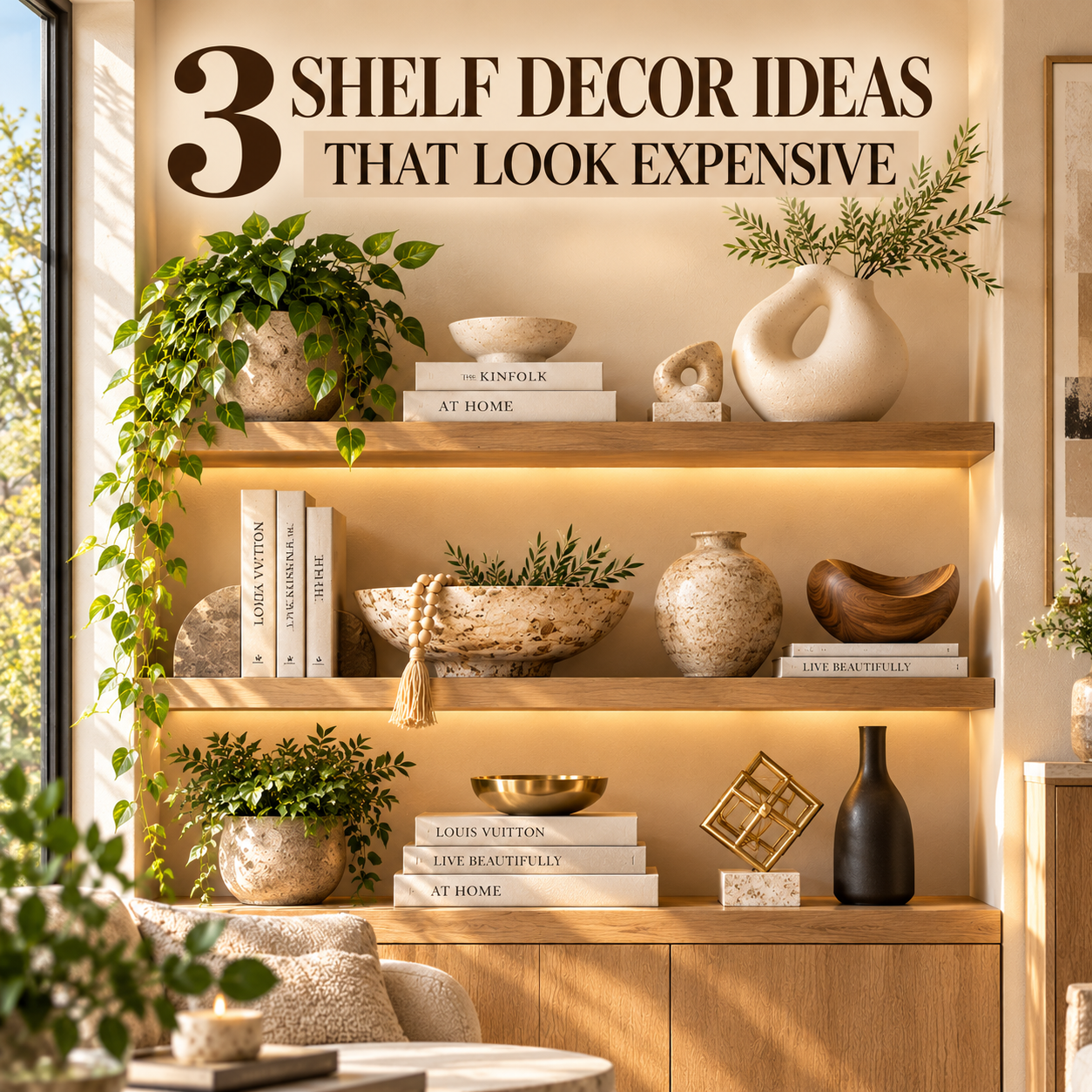
A beautifully styled shelf can completely change how a space feels. An ordinary bookcase becomes an elegant display. A simple floating shelf transforms into a miniature art gallery. Even a narrow shelf in a small apartment can feel remarkably luxurious when every decorative piece has a clear purpose.
✨ The most expensive-looking shelves often contain fewer objects than expected.
Rather than filling every available inch, sophisticated minimalist shelf styling allows individual pieces to stand out. Sculptural ceramics, carefully arranged books, natural stone accents, and subtle architectural details work together to create visual interest without unnecessary clutter.
The most successful arrangements are also surprisingly achievable. Many require only three or four decorative objects, making them ideal for anyone who wants beautiful interiors without constantly purchasing new accessories.
Whether the goal is a refined contemporary look, a warmer organic atmosphere, or a striking architectural display, these Best 3 Minimalist Shelf Decor Ideas offer three distinctive approaches to creating shelves that feel intentional, balanced, and beautifully expensive.
Why Minimalist Shelf Decor Looks More Expensive Than Overdecorated Shelves
There is something immediately sophisticated about a shelf that feels calm and carefully composed.
In professionally designed interiors, decorative objects are rarely arranged randomly. Their placement considers height, shape, visual weight, texture, and the relationship between occupied and empty space.
A single oversized ceramic vessel can create more impact than a collection of ten smaller ornaments. Similarly, two beautifully selected books may look more luxurious than a crowded arrangement of mismatched decorative accessories.
This happens because minimalist styling directs attention toward individual details.
When a shelf contains fewer objects, the eye can appreciate the texture of handmade ceramics, the natural variations in stone, or the beautiful shape of an abstract sculpture.
The surrounding empty space becomes part of the design.
The Secret Behind Beautifully Curated Shelves
A successful minimalist shelf arrangement usually combines three fundamental qualities: visual hierarchy, material harmony, and breathing room.
Visual hierarchy means that one object attracts attention first. Supporting accessories then guide the eye through the composition without competing for attention.
Material harmony creates a cohesive appearance through complementary textures and finishes. Natural wood, matte ceramics, brushed metal, and stone are particularly effective because their surfaces offer interest without relying on complicated patterns.
Breathing room prevents the arrangement from looking crowded.
A shelf does not need decorations across its entire width. In fact, deliberately leaving certain sections open can make the remaining objects feel more important.
🏡 The objective is to create a display that looks collected and considered rather than purchased and arranged all at once.
Why Shelf Proportions Matter More Than the Number of Accessories
A common decorating mistake is choosing objects that are too small for the available shelf.
Several tiny decorations may seem minimal individually, but together they can produce a busy, fragmented appearance.
Larger pieces often create a cleaner composition.
For example, a wide shelf might look beautiful with one tall vase, a short horizontal stack of books, and a compact sculptural object.
The contrast between those three forms creates enough variation to maintain interest.
Their proportions also make the overall arrangement feel more substantial.
The following three ideas demonstrate how to use these principles in different ways, without turning minimalist shelf styling into another general room-decorating project.
🥇 Best 1 Minimalist Shelf Decor With Sculptural Ceramics and Gallery Inspired Styling
The first and most sophisticated Minimalist Shelf Decor idea focuses on sculptural ceramics arranged like a small contemporary art exhibition.
Instead of using shelves primarily to display collections, this approach treats each shelf as a carefully composed gallery.
The centerpiece is a striking ceramic vessel with a distinctive silhouette. Surrounding accessories remain deliberately understated, allowing the main object to become the visual focus.
Imagine a beautiful light-oak floating shelf against a softly textured ivory wall.
At one end stands an oversized matte ceramic vase with an asymmetrical opening and a gently curved silhouette. Beside it sits a small stack of neutral art books, topped with a smooth stone object.
The opposite end remains almost completely empty.
The result feels remarkably refined.
Nothing looks crowded, and every object has enough space to reveal its shape, texture, and personality.
This approach is particularly effective for anyone who appreciates contemporary art, architectural forms, and quiet luxury.


Choose One Statement Ceramic Piece for Minimalist Shelf Decor
The most important decorative element is the statement ceramic.
Rather than selecting several equally prominent pieces, choose one vessel with enough visual presence to anchor the composition.
An oversized ceramic vase with an irregular opening works beautifully because its shape becomes interesting even without flowers.
A rounded sculptural vessel can introduce softness, while a taller cylindrical form creates architectural elegance.
The finish matters just as much as the silhouette.
Matte ceramics often look sophisticated because they absorb light softly and reveal subtle variations in their surface.
Beautiful choices include:
- 🤍 Chalk-white ceramic with a slightly irregular handmade surface
- 🏺 Warm beige stoneware with a softly curved silhouette
- 🪨 Limestone-inspired pottery with delicate natural texture
- 🖤 Matte charcoal ceramic with a simple architectural profile
- ✨ Ivory sculptural vases featuring organic openings or cutouts
Avoid choosing multiple statement objects that compete for attention.
If the main vase has a dramatic shape, supporting pieces should remain quieter.
The goal is contrast between one expressive object and a few simpler forms.
Create an Art Gallery Effect With Deliberate Spacing
Gallery-inspired styling depends on the relationship between objects and empty space.
Begin with a completely cleared shelf.
Place the largest ceramic vase slightly off-center rather than directly in the middle.
This immediately introduces an asymmetrical composition that feels more contemporary.
Next, add a short stack of two or three books toward the opposite side.
A small stone sphere, minimalist candleholder, or compact abstract sculpture can sit near the books to create another point of interest.
Leave a clearly visible area of open shelf between the two groups.
This empty section allows both arrangements to feel more important.
It also prevents the display from resembling a traditional collection of ornaments.
For an especially sophisticated effect, avoid perfectly symmetrical spacing. Let the arrangement appear natural while maintaining a clear visual balance.
Use Vertical and Horizontal Shapes for Contrast
One reason gallery-inspired shelf displays look so polished is the deliberate contrast between different silhouettes.
A tall ceramic vase introduces a strong vertical line.
A horizontal stack of books creates a lower, wider shape.
A small rounded sculpture softens the relationship between the two.
Together, these forms create visual movement.
This is more effective than using three similarly sized vases, which can appear repetitive and overly coordinated.
The eye naturally moves between the tall, low, and rounded elements.
To make the arrangement feel even more luxurious, use objects with visibly different surface finishes.
A matte ceramic vase beside a smooth marble-like object creates subtle texture contrast without introducing additional colors.
Choose a Restrained Gallery Color Palette
Gallery-inspired Minimalist Shelf Decor works particularly well with colors that emphasize form rather than decoration.
Warm white, ivory, limestone, pale taupe, and charcoal create a sophisticated foundation.
Natural wood adds warmth, while a small amount of dark contrast can prevent the arrangement from looking flat.
For example, an ivory vase looks beautiful against a pale oak shelf when paired with a small black sculptural accent.
Alternatively, a charcoal ceramic vessel can create striking contrast against light-colored shelving.
The essential principle is restraint.
Keep the palette concentrated around two or three related colors, allowing interesting silhouettes to provide the visual complexity.
How to Make Gallery Inspired Shelf Styling Look Professionally Designed
A professional-looking gallery display requires careful adjustment rather than complicated decoration.
First, observe the arrangement from the point where it will normally be viewed.
A display that looks balanced from directly in front may appear crowded when seen from a doorway or nearby seating area.
Next, check whether the tallest object has enough clearance above it.
A vase positioned too close to the underside of the next shelf can appear cramped.
Then, consider the relationship between the shelf’s depth and the decorative objects.
Shallow shelves work best with compact vessels and small sculptures, while deeper shelves can accommodate larger architectural pieces.
Finally, resist adding another accessory simply because an empty section remains.
Empty space is a defining feature of this style.
💎 Best for: Contemporary floating shelves, display niches, open shelving with generous spacing, and homeowners who prefer artistic minimalism.
🥈 Best 2 Minimalist Shelf Decor With Natural Stone and Warm Organic Textures
The second Minimalist Shelf Decor idea introduces a warmer and more tactile approach through natural stone, handcrafted materials, and subtle organic shapes.
While the first idea celebrates sculptural contrast, this arrangement emphasizes the quiet beauty of natural materials.
The overall effect is soft, grounded, and sophisticated.
Imagine a solid walnut shelf displaying a low travertine bowl, a small handmade clay vessel, and a beautifully textured decorative object in natural wood.
The arrangement contains only a few pieces, yet each contributes a different sensory quality.
The travertine reveals delicate mineral patterns.
The clay vessel has a subtle handcrafted finish.
The wooden object introduces natural grain and warmth.
Together, these materials create a display that feels expensive without relying on reflective metallic surfaces or elaborate ornaments.
This is an excellent option for minimalist interiors that need warmth without additional visual clutter.

Build Minimalist Shelf Decor Around a Natural Stone Centerpiece
Natural stone is one of the most effective materials for creating a luxurious appearance.
Travertine, marble, limestone, and similar stone finishes introduce distinctive textures that are difficult to replicate through plain decorative accessories.
A shallow travertine bowl can serve as the central object in an organic minimalist shelf arrangement.
Its low profile helps ground the composition, while its natural variations add visual interest.
A small marble sphere provides a more sculptural appearance.
A limestone-inspired decorative block creates a stronger architectural effect.
For narrow shelves, consider a compact stone object rather than a heavy bowl.
Weight and stability are important, especially when styling wall-mounted shelves.
A beautifully chosen lightweight stone-look accessory may be more practical than solid stone on shelving with limited load capacity.
Pair Rough and Smooth Surfaces for Subtle Luxury
One of the easiest ways to create depth in a minimalist arrangement is by combining contrasting textures.
A smooth ceramic vessel becomes more interesting beside rough travertine.
A natural wood object gains visual richness when placed near polished stone.
A softly textured clay accessory can balance a cleaner, more geometric piece.
The contrast should feel subtle rather than dramatic.
For example, begin with a warm beige travertine bowl.
Add a small cream ceramic vase with a gently uneven surface.
Finish with a compact walnut object featuring a smooth rounded silhouette.
Each material has its own character, but the shared warm-neutral colors prevent the arrangement from becoming visually busy.
This approach demonstrates why expensive-looking decor does not always require expensive materials.
Beautiful composition can elevate even affordable accessories.
Use Organic Shapes Without Losing Minimalist Structure
Organic design often incorporates curved, imperfect, or naturally inspired forms.
However, a minimalist display should still maintain visual structure.
Instead of arranging several irregular pieces randomly, combine an organic centerpiece with one or two simpler supporting shapes.
A curved stone bowl looks particularly effective beside a vertical cylindrical vessel.
A rounded wooden sculpture can work beautifully near a rectangular decorative book.
The contrast makes the organic forms more noticeable.
It also prevents the display from appearing overly rustic or unfinished.
🌿 Organic minimalism works best when the materials feel natural but the arrangement remains deliberate.
Create a Warm Neutral Palette With Material Variations
Warm organic shelf styling benefits from subtle differences within a narrow color family.
Cream, sand, mushroom, oatmeal, walnut, and muted clay tones are particularly suitable.
The colors should complement one another without blending into an indistinct collection.
A warm beige shelf arrangement might include a darker walnut accent to create depth.
A pale stone display could benefit from a small charcoal ceramic object.
A honey-toned wood shelf may look more balanced with cool ivory stone accessories.
Rather than choosing every piece in exactly the same color, allow slight variations in warmth and saturation.
These differences create dimension while preserving the quiet atmosphere.
Use Small Natural Objects Instead of Excessive Greenery
Minimalist shelf styling does not always require plants.
Although greenery can add life to a display, large trailing plants or numerous small pots may dominate the visual composition.
For a more architectural organic arrangement, natural objects can provide a similar connection to nature.
A small piece of sculptural driftwood, a polished river stone, or a simple wooden sphere introduces organic character without demanding additional space.
If greenery is desired, choose one restrained botanical accent.
A single stem in a narrow ceramic vase may be enough.
For example, an elegant olive branch placed inside a small stoneware vessel introduces movement while preserving the overall simplicity.
The purpose is to complement the materials rather than create a miniature indoor garden.
Make Organic Shelf Styling Feel Collected Rather Than Matching
One mistake that can make minimalist shelves look inexpensive is using an entire matching accessory set.
Although matching decorations create consistency, they can also make the display feel artificial.
A more convincing arrangement combines objects with slightly different origins, textures, and silhouettes.
A vintage wooden object beside a contemporary stone bowl can look exceptionally stylish.
A handmade ceramic vessel works beautifully with a simple modern decorative accessory.
A naturally weathered object can provide contrast against a perfectly smooth shelf.
The arrangement should feel curated over time rather than assembled from identical products.
To maintain cohesion, repeat one unifying element, such as warm undertones, rounded silhouettes, or natural matte finishes.
💎 Best for: Walnut shelves, oak bookcases, open display ledges, neutral interiors, and anyone who prefers tactile materials over decorative patterns.
🥉 Best 3 Minimalist Shelf Decor With Architectural Book Stacks and Modern Metal Accents
The third Minimalist Shelf Decor idea combines carefully arranged books, strong geometric lines, and subtle metallic details.
This approach feels more structured than organic styling and more functional than a purely sculptural gallery display.
It is particularly attractive for people who want their shelves to look sophisticated while still displaying books and meaningful personal items.
Imagine a slim floating shelf with three oversized hardcover books stacked horizontally.
A small brushed-brass geometric sculpture rests beside them.
At the opposite end stands a tall, narrow decorative object with a matte black finish.
The arrangement feels deliberate, architectural, and subtly luxurious.
The books create a foundation.
The metal accent introduces a refined highlight.
The vertical object completes the composition.
The overall result is modern, balanced, and visually distinctive.

Style Minimalist Shelf Decor With Carefully Selected Books
Books are among the most versatile shelf styling accessories because they introduce shape, texture, and personality at the same time.
However, their arrangement has a significant influence on the overall appearance.
For minimalist styling, a small group of larger hardcover books often looks more sophisticated than numerous thin paperbacks arranged without structure.
Choose books with beautiful covers or spines that complement the color palette.
Architecture, art, photography, design, and travel books are especially attractive when their subjects genuinely interest the homeowner.
Arrange two or three books horizontally to create a stable base.
A compact sculptural object can sit on top, provided the stack remains secure.
Alternatively, place a short vertical grouping beside a horizontal stack to introduce directional contrast.
Avoid arranging every book identically.
Variation makes the display feel naturally curated.
Use Brushed Brass or Matte Black Metal for Subtle Contrast
Metallic accessories can make minimalist shelves feel more luxurious when used sparingly.
Brushed brass introduces warmth and gentle reflection.
Matte black metal creates sharper architectural contrast.
Satin nickel offers a cooler contemporary appearance.
The goal is to use metal as a small accent rather than the dominant material.
A slim brass bookend can create an elegant detail beside neutral hardcovers.
A small geometric sculpture in matte black provides contrast against pale shelving.
A brushed-metal decorative arch introduces height without overwhelming the arrangement.
Choose one primary metal finish rather than mixing several unrelated metallic colors.
This keeps the arrangement visually cohesive.
✨ A single thoughtfully chosen metallic accent usually creates a more sophisticated impression than several shiny ornaments competing for attention.
Create Architectural Lines With Books and Decorative Objects
Architectural shelf styling depends on a strong relationship between straight lines and simple shapes.
Rectangular books naturally create horizontal layers.
A tall narrow vase introduces vertical movement.
A circular or curved metal sculpture can soften the geometry.
These different forms work together to create a balanced composition.
For example, position a horizontal stack of three books toward the left side of the shelf.
Place a narrow vertical object near the right side.
Introduce one small rounded accent between them.
The arrangement now contains three distinct visual forms without unnecessary complexity.
Carefully consider their relative sizes.
If the book stack is substantial, the vertical object should have enough height to balance it.
If the metallic accent is visually bold, the surrounding pieces should remain understated.
Make Books Look Decorative Without Hiding Their Personality
A beautifully styled minimalist shelf should still feel personal.
There is no need to select books exclusively because their covers match the room.
Instead, use a small collection of genuinely interesting books and arrange them thoughtfully.
If colorful spines disrupt the chosen palette, place selected books horizontally with their covers visible when appropriate.
Another option is to group books with similar visual weight while allowing the colors to vary slightly.
A photograph, meaningful souvenir, or personal keepsake can also become part of the arrangement.
The important consideration is scale.
One meaningful object displayed prominently often has more impact than several small souvenirs competing for attention.
This creates an appealing relationship between elegant styling and authentic personality.
Use Visual Rhythm Across Multiple Shelves
When decorating a bookcase with several shelves, avoid repeating the exact same arrangement on every level.
Instead, create visual rhythm by alternating the position of books and accessories.
For example, the top shelf might feature a tall ceramic object on the left.
The middle shelf could contain a horizontal book stack toward the right.
The lower shelf might display a small architectural sculpture near the center.
This movement encourages the eye to travel naturally through the bookcase.
It also prevents the arrangement from looking overly symmetrical or staged.
Repeat one or two colors throughout the shelves to maintain visual consistency.
A black accent on the upper shelf can connect with a similar detail below.
A small brass object can echo a subtle metallic finish elsewhere in the display.
The repetition should feel quiet and intentional.
💎 Best for: Contemporary bookshelves, home-office shelving, slim floating shelves, and interiors that combine functionality with refined architectural design.
Best 3 Minimalist Shelf Decor Ideas Compared
Each of the three approaches offers a different way to achieve sophisticated shelf styling.
The right choice depends on the shelf dimensions, preferred materials, existing decorative objects, and desired visual effect.
| Minimalist Shelf Decor Idea | Main Decorative Elements | Overall Appearance | Best Shelf Type |
|---|---|---|---|
| 🥇 Sculptural Ceramic Gallery | Statement vase, small sculpture, neutral books | Artistic, refined, gallery-inspired | Floating shelves and display niches |
| 🥈 Organic Stone and Natural Textures | Travertine bowl, handmade pottery, wooden accents | Warm, tactile, naturally luxurious | Oak and walnut shelves |
| 🥉 Architectural Books and Metal | Hardcover books, metal sculpture, geometric accents | Structured, modern, sophisticated | Bookcases and narrow display shelves |
The gallery-inspired approach is ideal when the shelf serves primarily as a decorative focal point.
Organic stone styling suits spaces where warmth and material texture matter most.
Architectural book styling is particularly useful when the shelf needs to accommodate both decorative accessories and frequently used books.
Although the approaches are distinct, a few principles can be borrowed across them.
A small stone accent may complement a ceramic gallery display. A restrained metallic detail can enhance an organic arrangement. A sculptural vase can introduce softness to an architectural bookshelf.
The strongest combinations preserve one dominant aesthetic rather than blending every decorative style equally.
How to Choose the Right Minimalist Shelf Decor for Your Shelf Size
The dimensions of a shelf influence which objects will look balanced.
A narrow shelf requires a different arrangement from a long floating ledge or a deep bookcase.
Proportion should guide the selection of accessories before color or material.
Minimalist Shelf Decor for Narrow Floating Shelves
Narrow floating shelves benefit from slim, lightweight objects with restrained depth.
A small ceramic vase, two compact books, and a miniature sculpture may be sufficient.
Avoid placing a large bowl near the shelf’s front edge.
Deep objects can appear awkward on narrow ledges and may create practical stability concerns.
For a narrow shelf, emphasize vertical silhouettes rather than bulky horizontal accessories.
A tall but stable ceramic vessel can create visual height without occupying excessive surface space.
Keep the arrangement simple so the shelf itself remains visible.
Minimalist Shelf Decor for Long Wooden Shelves
Long shelves offer more flexibility, but they also create a temptation to fill every available section.
Instead, divide the shelf visually into two or three loose areas.
Each area can contain one focal object or a small group of related accessories.
A long shelf might feature a ceramic vessel near one end, a low book stack near the center, and a small natural stone accent toward the opposite side.
The areas should not feel equally crowded.
Allow one section to remain noticeably lighter.
This creates an appealing sense of movement and makes the overall display look carefully composed.
Minimalist Shelf Decor for Deep Bookcases
Deep bookcases allow decorative objects to be layered from front to back.
This can create visual depth, but excessive layering quickly makes the display look crowded.
Choose a larger object as the main focal point and position a smaller accessory slightly forward or to one side.
Avoid hiding attractive pieces behind multiple overlapping decorations.
If the bookcase contains several compartments, alternate between more decorative and more functional shelves.
Some compartments may contain books, while others feature a single sculptural piece.
This variation produces an attractive rhythm without requiring every section to become a decorative arrangement.
The Best Color Combinations for Expensive Looking Minimalist Shelves
Color coordination is one of the most effective ways to make affordable shelf decor look sophisticated.
The goal is not necessarily to match every object.
Instead, choose a restrained family of colors that allows differences in form and texture to become the main visual interest.
Ivory and Natural Oak for Soft Luxury
Ivory and oak create a light, welcoming appearance.
The warmth of the wood balances the simplicity of pale ceramics.
This combination looks particularly beautiful with matte pottery, neutral books, and small stone accessories.
Consider using several related ivory shades rather than relying on one uniform white.
Warm cream, chalk, and light beige introduce subtle variation.
A single dark accent can add definition when the display needs more contrast.
Walnut and Travertine for Rich Organic Elegance
Walnut and travertine create a warmer and more substantial appearance.
The darker wood provides visual depth, while the pale stone brightens the composition.
A simple travertine bowl on a walnut shelf can feel remarkably luxurious.
Add one handmade ceramic object in a complementary warm tone to complete the arrangement.
Avoid introducing too many contrasting finishes.
The relationship between wood grain and natural stone already provides plenty of visual interest.
Charcoal and Warm White for Modern Architectural Contrast
Charcoal and warm white create a more graphic appearance.
This combination works beautifully with geometric sculptures, book stacks, and narrow decorative vessels.
A charcoal object against a warm-white background becomes a strong focal point.
However, excessive contrast can make a shelf feel fragmented.
Balance the arrangement by using one dominant color and introducing the second as an accent.
For a softer result, replace pure black with dark bronze, graphite, or muted charcoal.
How to Arrange Minimalist Shelf Decor Without Making It Look Empty
A common concern with minimalist decorating is that removing accessories will make a display feel unfinished.
However, minimalist shelves do not need to feel sparse or impersonal.
The difference lies in thoughtful composition.
A shelf feels unfinished when the objects lack visual relationships.
It feels intentionally minimal when those relationships are clear.
Use Three Distinct Visual Heights
One useful styling technique is combining objects at three different heights.
Begin with a taller anchor piece.
Introduce a medium-height accessory.
Complete the arrangement with a lower object, such as a shallow bowl or horizontal book stack.
The differences in height encourage the eye to move naturally through the display.
They also prevent the arrangement from forming one monotonous line.
The heights do not need to follow a perfect sequence.
An asymmetrical arrangement often looks more sophisticated than a rigid staircase.
Group Objects Instead of Spreading Them Evenly
Spacing every accessory at identical intervals can make a shelf look like a retail display.
Grouping objects creates a more natural composition.
For example, a small vase can sit beside two stacked books while the remaining shelf stays open.
The objects form one intentional arrangement rather than three unrelated decorations.
Another option is creating two small groups separated by a larger area of empty space.
This approach works particularly well on long shelves.
The arrangement should appear balanced as a whole, even when the individual objects are not positioned symmetrically.
Let Negative Space Become Part of the Design
Negative space is the unoccupied area surrounding decorative objects.
It is one of the defining characteristics of sophisticated minimalist shelf styling.
Without negative space, even beautiful accessories can lose their impact.
Try removing one object from an arrangement that feels slightly crowded.
Then observe whether the remaining pieces become more noticeable.
Often, the display immediately appears calmer and more intentional.
There is no universal percentage of shelf space that must remain empty.
The appropriate amount depends on object scale, shelf length, and the surrounding environment.
What matters is that every focal piece has enough room to be appreciated.
📌 Important Note: Always check the shelf manufacturer’s weight limits and installation requirements before placing heavy ceramics, stone bowls, or decorative book stacks on floating shelves. Expensive-looking styling should never compromise stability or safety. Keep heavier objects securely positioned and avoid unstable arrangements near shelf edges.
Affordable Ways to Make Minimalist Shelf Decor Look Luxurious
An expensive-looking shelf does not require luxury designer accessories.
Material appearance, scale, and composition often matter more than the original purchase price.
A carefully selected thrift-store vase may look beautiful beside a few well-loved books.
A simple ceramic bowl can become a sophisticated focal point when positioned correctly.
Even objects already available at home can be rearranged into a completely different composition.
Choose Quality Looking Finishes Over Complicated Decoration
Affordable accessories often look more luxurious when their design is simple.
Instead of choosing objects with numerous decorative details, focus on attractive shapes and convincing surface finishes.
Matte ceramic, textured stoneware, smooth wood, and understated metallic finishes are especially versatile.
Avoid pieces with visibly uneven artificial metallic coatings or lightweight finishes that unintentionally imitate more substantial materials.
The objective is not to disguise every affordable object as an expensive designer piece.
It is to choose decorations that look beautiful on their own.
Shop Your Existing Home Before Buying New Accessories
One of the easiest ways to refresh minimalist shelves is to rearrange existing objects.
A vase from a dining table may work beautifully on a floating shelf.
A hardcover book stored in a cabinet could become an attractive base for a sculpture.
A small wooden keepsake might provide exactly the natural texture missing from an arrangement.
Gather several possible accessories in one place before styling.
This makes it easier to compare shapes, colors, and sizes.
Then select the strongest pieces rather than using everything available.
A thoughtful edit often creates a more refined result than purchasing an entirely new collection.
Invest in One Strong Focal Object
If the decorating budget allows for one special purchase, prioritize a focal object.
A beautifully shaped ceramic vessel, distinctive stone bowl, or elegant geometric sculpture can anchor an entire shelf arrangement.
Supporting accessories can remain affordable and understated.
This creates a clear hierarchy.
The statement object provides the visual identity, while the smaller pieces complete the composition.
It is usually more effective than spending the same amount on numerous tiny decorative items.
Common Minimalist Shelf Decor Mistakes That Make Shelves Look Cluttered
Even a small collection of beautiful accessories can look disorganized when the composition lacks balance.
Understanding common mistakes makes it easier to create a polished display.
Using Too Many Small Decorative Objects
Numerous miniature decorations can create visual noise.
Instead of displaying several small ornaments across an entire shelf, select fewer objects with stronger shapes.
A medium-sized ceramic vessel and one small sculpture may look more sophisticated than eight unrelated accessories.
The larger pieces establish a clear focal point.
The arrangement becomes easier to appreciate from across the room.
Matching Every Accessory Perfectly
Perfectly matching accessories can make a shelf appear overly staged.
A collection of identical ceramic vases may look coordinated but lack character.
Introduce subtle differences in height, texture, and silhouette.
A matte vase beside a smooth stone bowl creates more interest than two identical pieces.
Cohesion should come from complementary relationships rather than exact repetition.
Ignoring the Visual Weight of Objects
Visual weight refers to how strongly an object attracts attention.
A small dark sculpture may feel visually heavier than a larger pale ceramic vase.
Similarly, a reflective metallic accessory may attract attention more quickly than a neutral stone object.
Balance these differences thoughtfully.
If one side of a shelf contains a dark focal piece, the opposite side may need a larger but lighter-colored object to maintain visual equilibrium.
The arrangement does not need to be symmetrical.
It simply needs to feel stable and intentional.
Filling Every Shelf in a Bookcase
A bookcase with multiple compartments can become overwhelming when every compartment contains decorative accessories.
Allow variation.
One shelf may feature books.
Another can display a statement ceramic.
A third might remain almost empty.
This alternating rhythm creates a sophisticated appearance while preserving the practical purpose of the furniture.
How to Keep Minimalist Shelf Decor Beautiful Over Time
A beautifully styled shelf should be easy to maintain.
Minimalist arrangements have a practical advantage because fewer objects generally mean less frequent rearranging and easier cleaning.
However, regular maintenance still matters.
Dust can become especially noticeable on dark surfaces, smooth stone accessories, and matte ceramics.
Clean objects according to their materials and avoid abrasive products that may damage delicate finishes.
When returning accessories to the shelf, preserve the intended spacing.
Small changes can gradually make an arrangement feel crowded, especially when new objects are added over time.
Refresh the Arrangement Without Replacing Everything
A shelf can feel new simply by changing the position of a few accessories.
Move the statement vase from one side to the other.
Replace a horizontal book stack with a vertical grouping.
Exchange a rounded sculpture for a more geometric object.
These small adjustments change the visual rhythm without requiring an entirely new collection.
Seasonal updates can also remain subtle.
Instead of introducing numerous themed ornaments, consider replacing one botanical stem, changing a small decorative object, or introducing a different natural texture.
This keeps the shelf visually interesting while preserving its minimalist identity.
Keep Personal Meaning at the Center of the Display
Minimalist styling should never require removing every meaningful possession.
A small heirloom, favorite book, or beautiful object collected during travel can become the most interesting feature on a shelf.
The key is giving that object an intentional place.
Surround it with quieter supporting elements rather than competing decorations.
This allows personal objects to feel special.
A shelf that combines beautiful styling with genuine meaning often feels more compelling than one designed entirely around trends.
Frequently Asked Questions About Minimalist Shelf Decor
What Should I Put on a Minimalist Shelf?
A minimalist shelf can feature a ceramic vase, a short stack of books, one small sculpture, or a natural stone accessory.
The ideal combination depends on the available space and desired appearance.
Choose objects with complementary materials and different heights.
Rather than filling the shelf, create one or two intentional groupings with visible negative space.
This allows each accessory to contribute to the composition without creating clutter.
How Do You Make Cheap Shelves Look Expensive?
Begin by removing unnecessary accessories and creating a clear focal point.
Use a restrained color palette and select decorative objects with simple, sophisticated silhouettes.
Matte ceramics, hardcover books, natural wood, and attractive stone-look finishes can help create a refined appearance.
Pay attention to spacing and proportion.
A thoughtfully arranged shelf with affordable accessories can look more sophisticated than an expensive shelf filled with unrelated decorations.
How Many Decorative Objects Should Be on One Shelf?
There is no fixed number that works for every shelf.
A short floating shelf may need only one or two objects.
A longer shelf may accommodate two or three small groupings.
The size of each accessory matters more than the total number.
A large sculptural vase may provide enough visual presence on its own, while smaller pieces may need to be grouped.
The goal is a balanced composition with enough open space to appreciate the individual objects.
Can Minimalist Shelf Decor Include Color?
Absolutely.
Minimalist styling does not require an entirely beige or white palette.
Muted green, terracotta, charcoal, dusty blue, and warm brown can all work beautifully.
The key is using color intentionally.
One muted green ceramic vessel may create a striking focal point among neutral accessories.
A small collection of similarly toned books can also introduce personality without overwhelming the arrangement.
What Is the Best Material for Minimalist Shelf Accessories?
Ceramic, natural wood, stone, glass, and understated metal are all excellent options.
The best material depends on the intended aesthetic.
Sculptural ceramics create an artistic appearance.
Stone and wood provide organic warmth.
Books and geometric metal accents produce a more structured, architectural effect.
Combining two or three complementary materials usually creates more depth than relying on a single finish throughout.
How Can I Style Minimalist Shelves Without Making Them Look Boring?
Focus on contrast in shape, height, and texture rather than adding more accessories.
A tall cylindrical vase beside a low rounded bowl creates an interesting silhouette.
A rough stone object paired with smooth ceramic introduces tactile contrast.
A small dark sculpture among lighter accessories creates a strong focal point.
These subtle relationships keep the display engaging while preserving the simplicity that makes minimalist styling appealing.
Final Thoughts on the Best 3 Minimalist Shelf Decor Ideas
Minimalist Shelf Decor proves that beautiful shelving does not depend on expensive accessories, elaborate displays, or perfectly matching decorative collections.
The most sophisticated arrangements are often the simplest.
They combine a few carefully chosen pieces with attractive materials, balanced proportions, and enough negative space to allow every object to stand out.
🥇 Sculptural Ceramics and Gallery Inspired Styling offer the most artistic approach. A statement ceramic vase, carefully selected supporting objects, and generous breathing room create a refined display reminiscent of a contemporary art gallery.
🥈 Natural Stone and Warm Organic Textures create a softer, more tactile atmosphere. Travertine, handcrafted pottery, and natural wood introduce understated luxury through material richness rather than decorative complexity.
🥉 Architectural Book Stacks and Modern Metal Accents provide a structured and functional alternative. Hardcover books, geometric sculptures, and restrained metallic finishes create a polished display with contemporary personality.
Each approach demonstrates a different form of minimalist elegance.
The most important decision is choosing a visual direction and allowing it to guide the selection of accessories.
Start with one beautiful focal object. Introduce a complementary shape or material. Adjust the spacing until the arrangement feels balanced. Then remove anything that does not contribute to the overall composition.
A shelf should not feel decorated merely because every available surface has been filled.
It should feel curated because the objects that remain genuinely belong there.
With thoughtful proportions, beautiful textures, and intentional simplicity, even the most ordinary shelf can become a quietly luxurious architectural detail that makes the surrounding space feel more refined.
The ultimate secret to expensive-looking minimalist shelves is not adding more beautiful things. It is giving the right beautiful things enough space to shine.
Related posts:
Best 3 Painting Pumpkins Ideas DIY Girly That Look Super Cute and Expensive
Best 3 Apartment Laundry Room Ideas That Make Small Spaces Look Surprisingly Luxurious
Best 3 Crochet Table Decorations That Make Any Dining Table Look Beautiful and Expensive
Best 3 Fabric Ceiling Ideas That Will Make Any Room Look Stunning and Expensive
Best 3 Plastic Pumpkins Makeover Ideas That Look Surprisingly Expensive
Best 3 Bookshelf Wallpaper Ideas That Make Any Wall Look Expensive

