A beautiful fall garland can completely transform a room without requiring an expensive seasonal makeover. Instead of filling every surface with pumpkins and autumn accessories, one carefully styled garland can introduce warm color, organic texture, and a sense of abundance exactly where the room needs it. Draped across a fireplace mantel, cascading around an entryway, or arranged naturally along a staircase, fall garlands have become one of the most versatile ways to decorate for autumn.

🍂 The most sophisticated fall garland ideas today are moving away from perfectly symmetrical arrangements and heavily artificial-looking foliage. Instead, the strongest designs borrow inspiration directly from nature. Think irregular branches, dried grasses, tiny berries, muted leaves, seed pods, miniature pumpkins, and foliage that appears to have been casually gathered from an autumn landscape.
The secret is layering.
Rather than treating a garland as a thin decorative string, imagine it as a miniature landscape that travels across an architectural feature. Some sections can be dense and dramatic, while others become airy enough to reveal the mantel, staircase railing, doorway, or table underneath.
Among countless possibilities, three approaches stand out for their beauty, flexibility, and ability to work in both traditional and contemporary interiors.
🥇 Best 1 Sculptural Botanical Fall Garland With Branches and Foliage
🥈 Best 2 Layered Harvest Fall Garland With Pumpkins Berries and Warm Texture
🥉 Best 3 Minimalist Fall Garland With Dried Leaves and Natural Neutrals
Each creates a very different autumn atmosphere while using the same fundamental principle: allowing natural texture to become the star.
🍁 Why Fall Garland Has Become an Essential Autumn Decorating Idea
Seasonal decorating can easily become overwhelming. Pumpkins appear on every table, wreaths cover every door, pillows change colors, and decorative objects gradually occupy every empty surface.
A fall garland offers a more architectural approach.
Instead of distributing dozens of small decorations throughout the house, the garland creates one strong visual line. It can emphasize the width of a fireplace, frame the height of a doorway, follow the movement of a staircase, or establish the center of a dining table.
That visual continuity makes the decoration feel intentional.
A long arrangement of autumn foliage also naturally guides the eye through a room. When placed on a fireplace mantel, for example, the garland connects objects that might otherwise look unrelated. Candlesticks, artwork, ceramic vessels, pumpkins, and branches suddenly become part of one composition.
🍂 Fall garland is especially effective because it combines color and texture without requiring permanent changes to the interior.
A neutral living room can remain neutral throughout the year while temporarily gaining amber leaves, burgundy berries, dried grasses, and warm brown branches during autumn.
Once the season ends, the architectural foundation of the room remains unchanged.
Best 3 Fall Garland Ideas at a Glance
Choosing the right style becomes easier when the garland is matched to the character of the room rather than simply copying a seasonal trend.
| Fall Garland Idea | Best Location | Main Materials | Overall Style | Color Direction |
|---|---|---|---|---|
| 🥇 Sculptural Botanical Garland | Fireplace or doorway | Branches, maple leaves, grasses, seed pods | Organic and dramatic | Rust, amber, olive, brown |
| 🥈 Layered Harvest Garland | Mantel or dining area | Pumpkins, berries, foliage, vines | Abundant and cozy | Burnt orange, burgundy, cream |
| 🥉 Minimalist Natural Garland | Modern mantel or console | Dried leaves, oak branches, grasses | Quiet and sophisticated | Beige, tan, muted brown |
The first option works beautifully when the garland itself should become a major decorative statement.
The second creates the richest traditional harvest atmosphere.
The third is ideal for interiors where autumn should be visible but restrained.
Let’s explore what makes each approach special.
🥇 Best 1 Sculptural Botanical Fall Garland With Branches and Foliage
The most visually striking fall garland does not necessarily look like a conventional garland at all.
Instead, it resembles a long botanical installation.
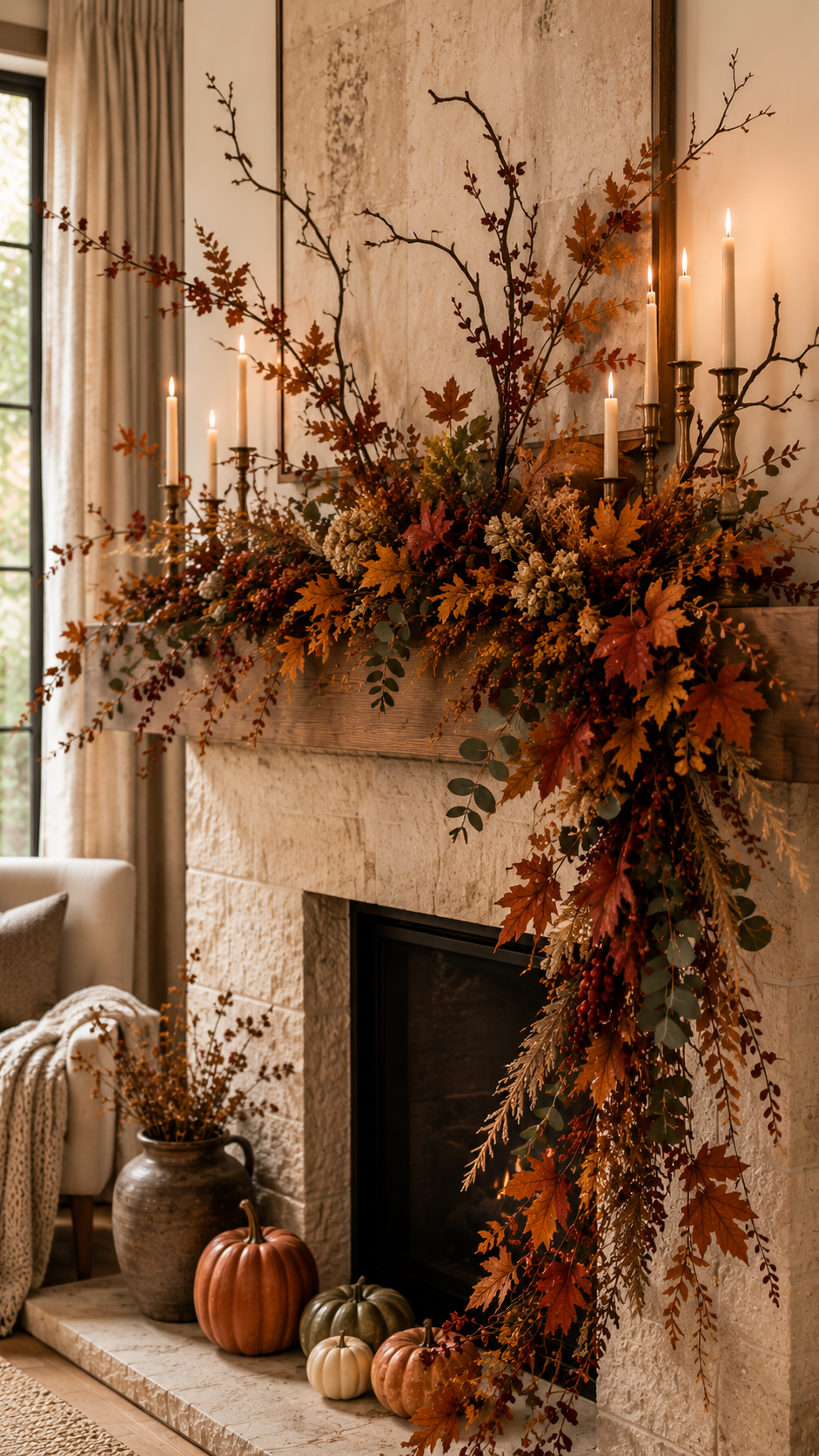
Imagine slender branches extending naturally across a fireplace mantel. Around them are layered maple leaves, oak foliage, delicate grasses, seed heads, dried hydrangea, and tiny berry clusters. Some branches rise vertically while others cascade gently over the edge.
The result feels much closer to an autumn landscape than a manufactured seasonal decoration.
This style works particularly well in sophisticated interiors because it introduces movement. Traditional garlands often create a uniform horizontal line. Sculptural arrangements break that line with different heights, textures, and directions.
🍁 One branch might extend dramatically upward.
Another might fall gently toward the floor.
A group of leaves may become dense near one end while the opposite side remains intentionally sparse.
That asymmetry is what makes the arrangement feel natural.
🍂 Creating an Organic Foundation for the Fall Garland
Every successful botanical garland begins with structure.
Instead of immediately adding colorful leaves, begin with the materials that determine the overall shape. Flexible branches, grapevine, eucalyptus stems, or artificial botanical stems with realistic branching structures can establish the skeleton.
Allow the foundation to extend beyond the surface being decorated.
For example, a fireplace garland becomes much more dramatic when several branches travel slightly beyond the width of the mantel rather than stopping exactly at each corner.
This creates the impression that the foliage naturally grew into place.
Avoid making every section equally dense.
Nature rarely distributes foliage perfectly.
Some areas should contain overlapping leaves and grasses while others should reveal glimpses of the branches underneath.
🌿 This combination of density and negative space creates visual depth.
Layer Autumn Foliage Instead of Using One Leaf Type
A common mistake with fall decorating is relying entirely on bright orange maple leaves.
They certainly communicate autumn, but using only one type of foliage can make the arrangement look artificial.
A more sophisticated fall garland idea combines multiple botanical shapes.
Consider layering:
- muted maple leaves
- oak leaves
- eucalyptus
- dried fern
- ornamental grasses
- seed pods
- berry branches
- dried hydrangea
- delicate vines
The colors do not need to match exactly.
In fact, subtle variation makes the arrangement more convincing.
Deep rust can sit beside faded amber. Olive foliage can soften orange leaves. Burgundy berries can create small moments of contrast.
The goal is not maximum color.
The goal is believable botanical richness.
🍁 Let the Fall Garland Cascade Naturally
One of the easiest ways to make a garland look luxurious is to introduce vertical movement.
Allow selected foliage to fall over the mantel edge rather than keeping everything horizontal.
A long vine can descend near one side of the fireplace.
Several grasses might curve outward.
A branch covered with leaves could extend diagonally downward.
These small movements prevent the garland from looking like a decorative strip placed on top of furniture.
Instead, the installation begins interacting with the architecture around it.
For an entryway, the same principle applies.
The garland can begin densely near one upper corner before becoming lighter as it travels down the opposite side.
This controlled asymmetry produces a relaxed editorial look.
Where This Fall Garland Works Best
The sculptural botanical approach is particularly effective around architectural focal points.
A limestone fireplace surrounded by warm white walls creates an ideal neutral background. Natural oak mantels also complement the organic texture beautifully.
Large entryways are another excellent location.
Instead of decorating the entire doorway uniformly, allow the botanical installation to become heavier on one side.
The result can feel almost like walking through an autumn garden.
🍂 Best for: interiors where the seasonal decoration should become a dramatic visual centerpiece.
🥈 Best 2 Layered Harvest Fall Garland With Pumpkins Berries and Warm Texture
For anyone who loves the unmistakable richness of autumn, the layered harvest garland delivers the strongest seasonal impact.
This design combines foliage with recognizable harvest elements such as pumpkins, berries, fruit, pinecones, and dried botanicals.
However, the modern interpretation is more refined than simply lining identical orange pumpkins across a mantel.
The most beautiful arrangements rely on variation.
Large elements anchor the composition while tiny details create richness between them.
Imagine an abundant garland flowing across a fireplace. Muted eucalyptus and autumn leaves form the botanical base. Small heirloom pumpkins appear between the foliage. Burgundy berry stems emerge from darker sections, while dried grasses introduce fine texture.
Several brass candlesticks rise behind the garland.
The entire arrangement feels warm and generous without becoming chaotic.

🎃 Use Small Pumpkins as Anchors
Pumpkins naturally attract attention because their rounded shapes contrast beautifully with thin branches and delicate leaves.
Instead of making them the entire theme, use them strategically.
Three or five small pumpkins are often more visually effective than a continuous row.
Choose different sizes.
A slightly larger pumpkin might anchor one end of the garland while two smaller varieties appear closer to the center.
Color selection matters too.
Bright orange is not the only possibility.
Try mixing:
🤍 creamy white pumpkins
🧡 muted terracotta pumpkins
🤎 warm brown varieties
🌿 pale sage pumpkins
🎃 traditional burnt orange pumpkins
This creates a more sophisticated harvest palette.
🍒 Add Berries for Small Bursts of Color
Berries are extremely useful because they add concentrated color without overwhelming the arrangement.
Deep burgundy berry branches work especially well with rusty leaves and cream pumpkins.
They also create tiny points of visual interest.
From across the room, the garland appears warm and textural. As someone moves closer, individual berries, seed pods, leaves, and branches become visible.
This layered viewing experience is one reason richly styled garlands photograph beautifully.
Not every detail needs to be immediately obvious.
Some should reveal themselves gradually.
Mix Smooth and Rough Autumn Textures
Texture often matters more than color.
Consider how different materials interact.
A pumpkin has a relatively smooth curved surface.
A pinecone is rough and geometric.
Dried grass is thin and feathery.
Leaves are flat and irregular.
Berries are small and glossy.
Branches are linear and textured.
Combining these characteristics prevents the fall garland from appearing visually flat.
Natural materials such as woven baskets, raw wood, linen, stone, and aged ceramics nearby can reinforce the same tactile atmosphere.
🕯️ Introduce Candlelight Around the Garland
Autumn decorating becomes especially beautiful as daylight fades.
Candles add another dimension because their warm glow emphasizes the textures inside the garland.
Tall taper candles can create elegant vertical lines behind a horizontal arrangement.
Chunky pillar candles provide a heavier, more rustic effect.
Glass hurricane lanterns work particularly well when a fireplace mantel needs additional height.
However, safety should always determine placement.
Important Note: Keep dried leaves, grasses, branches, fabric, and artificial foliage safely separated from open flames. Flameless LED candles can provide a similar warm atmosphere when the garland occupies the same surface.
The visual objective is to create the impression of candlelight emerging from the autumn foliage rather than placing candles randomly around it.
Create a Fall Garland That Feels Collected Over Time
A beautifully layered harvest arrangement should not appear as though every object came from the same seasonal décor collection.
Mixing materials helps.
An aged ceramic vessel could hold several tall branches.
Vintage brass candlesticks might sit beside matte pumpkins.
A weathered wooden bowl could contain pears or miniature gourds.
The garland becomes the connecting element between everything.
🍂 This is particularly effective in traditional, farmhouse, transitional, European-inspired, and Nancy Meyers-style interiors where warmth and collected character are central to the aesthetic.
The result feels comfortable rather than staged.
🥉 Best 3 Minimalist Fall Garland With Dried Leaves and Natural Neutrals
Not every autumn home needs dramatic orange foliage.
For modern, Scandinavian, Japandi, minimalist, or warm contemporary interiors, a restrained fall garland can often look more sophisticated.
The minimalist version focuses on shape and texture rather than obvious seasonal color.
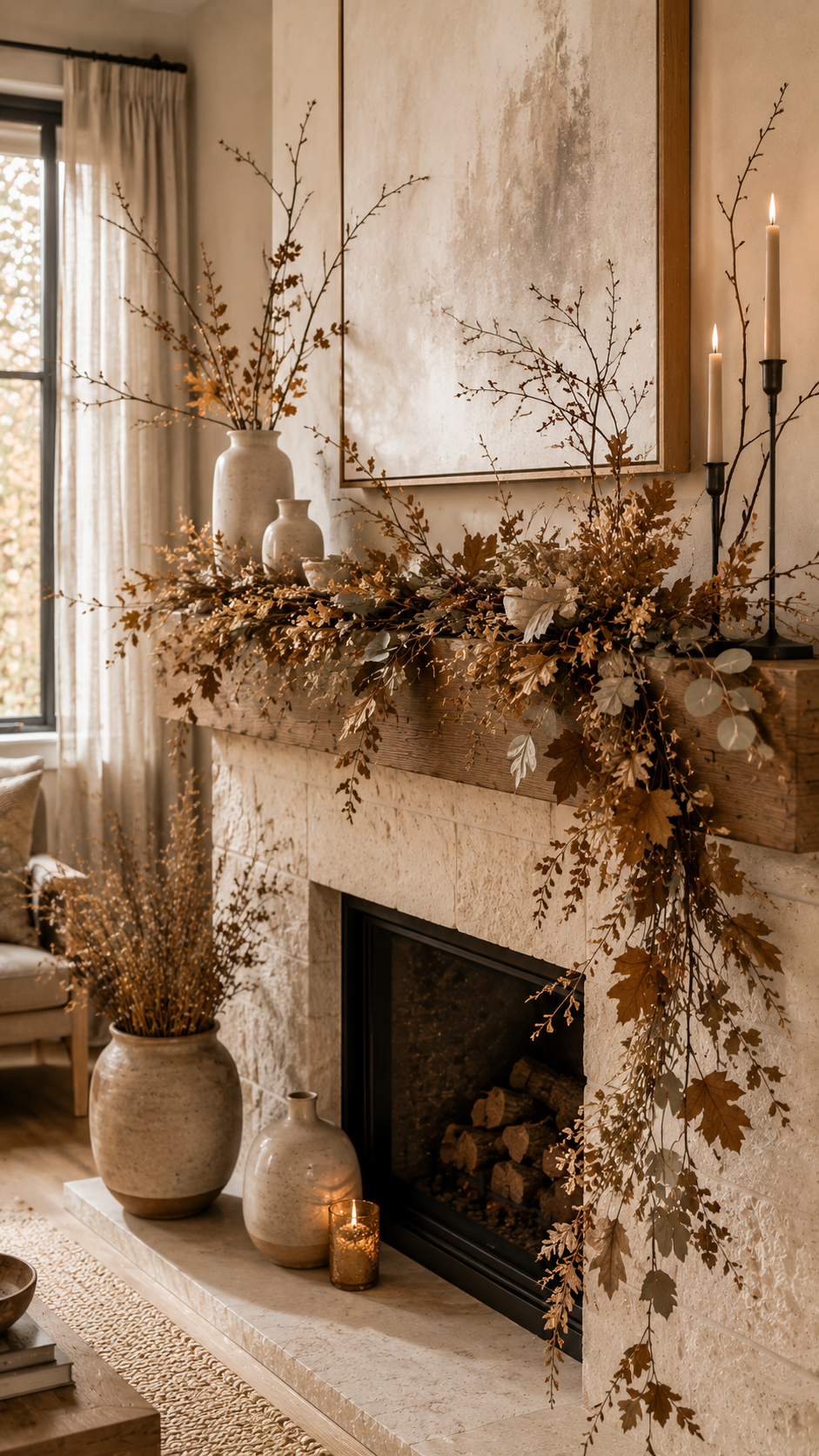
Imagine a pale limestone fireplace beneath an abstract painting.
Across the mantel runs a delicate arrangement of dried oak leaves, beige grasses, slender brown branches, and a few faded seed pods.
Perhaps two cream ceramic vessels sit nearby.
Nothing screams autumn.
Yet the entire composition unmistakably captures the quiet feeling of the season.
That subtlety is precisely the appeal.
🤎 Start With a Restrained Autumn Color Palette
Minimalist seasonal decorating becomes easier when the palette is decided before selecting materials.
Instead of combining every traditional fall color, choose three or four related tones.
For example:
warm beige
soft caramel
muted brown
faded olive
A second combination could include ivory, taupe, dusty rust, and dark brown.
These limited palettes allow texture to become more noticeable.
When colors are quiet, the eye begins paying attention to leaf shapes, branch structures, and material surfaces.
Use Dried Leaves as the Main Fall Garland Element
Dried leaves naturally provide muted autumn colors.
Their curled edges and imperfect surfaces also create a level of realism that perfectly uniform artificial leaves cannot easily reproduce.
Oak leaves are especially attractive because their recognizable silhouettes remain beautiful even after their color fades.
Magnolia leaves can introduce larger shapes.
Dried eucalyptus creates smaller rounded forms.
A combination of these materials produces variation without needing strong colors.
🍂 Allow some leaves to curl upward while others fall toward the surface.
That irregularity is desirable.
🌾 Introduce Grasses for Softness and Movement
Branches and dried leaves can become visually heavy if used alone.
Ornamental grasses solve the problem.
Their thin stems create airy transitions between denser botanical elements.
Pampas grass can work, but use it sparingly. Oversized pampas arrangements can easily dominate a minimalist garland.
Smaller grasses, wheat-like stems, or delicate seed heads often create a more refined result.
The objective is not to cover every empty space.
Minimalism depends on leaving portions of the underlying architecture visible.
Keep Decorative Accessories Extremely Simple
A restrained garland needs restrained surroundings.
Avoid adding numerous pumpkins, signs, figurines, and seasonal accessories.
Instead, choose one or two supporting elements.
A pair of ceramic vessels may be enough.
A sculptural wooden bowl could work.
Two oversized candlesticks can introduce height.
An abstract artwork or simple mirror above the mantel can complete the composition.
The garland should still remain visually dominant.
🤍 Best for: contemporary interiors where seasonal decoration should complement the existing architecture rather than temporarily replace it.
🍂 How to Make Any Fall Garland Look More Expensive
Expensive-looking seasonal décor rarely depends entirely on expensive materials.
Scale, proportion, color control, and layering matter much more.
One of the biggest improvements comes from increasing the apparent volume of the garland.
Thin garlands often look inexpensive because they reveal their underlying wire or central stem.
Layering additional foliage around that foundation immediately creates richness.
Another useful technique is extending the garland beyond the obvious boundaries of the furniture.
Instead of cutting the arrangement precisely at the edge of a six-foot mantel, allow foliage to extend slightly beyond it.
This visually enlarges the installation.
Mix Real and Artificial Botanical Materials
There is no requirement that every element come from the same source.
Combining realistic artificial foliage with genuine dried branches can produce excellent results.
Real branches provide irregular structures that are difficult to reproduce artificially.
Dried grasses introduce authentic fine textures.
High-quality artificial leaves provide color consistency and durability.
Together, they can create a convincing arrangement.
🌿 The important consideration is avoiding artificial foliage with excessive shine.
Real leaves generally have complex surfaces rather than a uniform plastic gloss.
Muted materials usually photograph and display more naturally.
🍁 Use More Than One Shade of Autumn
Autumn is not simply orange.
Walk through a natural landscape during fall and the palette can include dozens of colors.
There may be golden yellow, tobacco brown, olive green, burgundy, rust, faded red, pale beige, and nearly black branches.
Using several related tones gives a garland dimensionality.
A single orange color tends to flatten everything visually.
For an elegant interior, try making muted brown and olive the foundation while using orange only as an accent.
The seasonal feeling remains obvious but becomes much easier to integrate with existing furniture.
Where to Decorate With Fall Garland Beyond the Fireplace
The mantel may be the most popular location, but garlands can transform many other parts of the home.
In fact, unexpected placement can make the decoration feel even more creative.
🍂 Fall Garland Around the Front Door
A doorway provides an opportunity to create a large botanical statement.
Rather than using a perfectly symmetrical arch, consider concentrating foliage around one upper corner.
Branches can extend outward while smaller vines descend vertically.
Mini pumpkins or dried flowers can be incorporated near the base.
The asymmetrical design makes the entrance feel dramatic while maintaining a natural appearance.
Pair it with several larger pumpkins on the steps and simple lanterns nearby.
The result creates an inviting transition from the outdoor autumn landscape into the home.
Fall Garland Along a Staircase
Staircases naturally provide movement, making them ideal for garlands.
Attach foliage along the handrail or outer railing while allowing selected sections to cascade.
Avoid making every section identical.
A staircase garland looks more organic when some areas are dense and others are lighter.
Velvet or linen ribbon can be incorporated at several points rather than continuously wrapping the railing.
🎀 Deep chocolate, muted olive, rust, or dusty burgundy ribbon can add luxurious color without overpowering the foliage.
🍁 Fall Garland Across a Dining Table
A garland can also become an alternative to a traditional floral centerpiece.
Run a low botanical arrangement down the center of a long wooden table.
Keep the foliage relatively low so guests can see one another.
Miniature pumpkins, pears, dried leaves, berries, and small candleholders can be incorporated throughout.
This creates a continuous autumn landscape rather than one large arrangement in the center.
For special dinners, place linen napkins and simple ceramic plates around the garland.
Natural materials reinforce one another beautifully.
Fall Garland Over a Console Table
Console tables provide one of the easiest opportunities for seasonal styling.
A loose garland can travel across the tabletop while several branches rise from a large ceramic vessel.
Add a lamp, bowl, artwork, or mirror.
The arrangement can be much smaller than a fireplace garland while still creating a strong seasonal moment.
This is especially useful in apartments where there is no fireplace.
🍂 Fall Garland Around Windows
Windows offer another interesting possibility.
A delicate garland placed along the upper frame can soften the architectural lines without blocking natural light.
Use lighter materials here.
Thin vines, small leaves, and airy branches are better than heavy pumpkins or dense foliage.
When late-afternoon sunlight passes through translucent autumn leaves, the effect can be exceptionally beautiful.
How to Choose the Right Fall Garland for Your Interior Style
The best seasonal decoration should look like an extension of the existing home.
A rustic room and a minimalist room can both use autumn garlands, but the materials should be different.
For farmhouse interiors, combine eucalyptus, pumpkins, berries, wheat, and weathered wood.
For modern interiors, simplify the palette and focus on sculptural branches.
For traditional rooms, use richer foliage with burgundy, deep green, rust, and brass accents.
For Scandinavian spaces, concentrate on dried leaves, pale woods, beige textiles, and subtle grasses.
For European-inspired homes, use imperfect branches, antique pottery, muted botanicals, and aged metal finishes.
🏡 Matching the garland to the room prevents seasonal decorating from feeling disconnected.
🍁 Common Fall Garland Mistakes to Avoid
Even beautiful materials can produce disappointing results when the composition is poorly planned.
The most common problem is excessive symmetry.
Perfectly matching both sides can make botanical arrangements feel artificial.
A second issue is using foliage that is all the same size.
Large leaves need smaller textures around them.
Tiny berries need larger branches to provide structure.
Another mistake is overloading the arrangement with recognizable seasonal objects.
If pumpkins, pinecones, signs, bows, berries, acorns, sunflowers, candles, and figurines all compete for attention, the garland loses its visual hierarchy.
Choose a dominant idea.
Then support it.
🍂 For example, if foliage is the star, pumpkins should become accents rather than equal competitors.
How to Transition a Fall Garland From Early Autumn to Thanksgiving
One advantage of a well-designed garland is that it can evolve throughout the season.
In early fall, keep the arrangement relatively green.
Use olive foliage, eucalyptus, grasses, and only small amounts of amber.
As the season progresses, introduce deeper rust leaves and berry branches.
Closer to Thanksgiving, pumpkins, pears, pinecones, and warm candlelight can make the arrangement feel more abundant.
After Thanksgiving, many of the neutral branches can remain.
Remove the pumpkins and bright orange elements, then introduce evergreen foliage or subtle winter branches.
🌿 This modular approach reduces the need to completely redecorate every few weeks.
🍂 Final Styling Formula for an Editorial Fall Garland
When building a garland from scratch, thinking in layers makes the process much easier.
Begin with the structural layer.
These are the branches and vines that determine the overall silhouette.
Next comes the foliage layer.
Add leaves and greenery to establish volume.
Then introduce fine texture through grasses, berries, dried flowers, or seed pods.
Afterward, place several visual anchors such as pumpkins, ceramic vessels, or candlesticks.
Finally, adjust the arrangement.
Step several feet away and look at the overall silhouette.
If everything forms one straight line, introduce more height.
If one section feels too heavy, remove several elements rather than automatically adding more elsewhere.
If the arrangement feels flat, allow selected branches to extend forward or cascade downward.
✨ Depth is created by placing materials in front of, behind, above, and below one another rather than arranging everything on the same horizontal plane.
Best Fall Garland Idea for a Cozy Traditional Home
For a warm traditional home, 🥈 Best 2 Layered Harvest Fall Garland is difficult to beat.
Its combination of foliage, miniature pumpkins, berries, and candlelight immediately creates the richness associated with autumn.
The look works particularly well with fireplaces, wooden furniture, linen upholstery, antique brass, and warm neutral walls.
Keep the colors sophisticated by choosing burnt orange instead of neon orange and burgundy instead of bright red.
Cream pumpkins can provide enough contrast to keep darker foliage from feeling too heavy.
The finished arrangement should appear abundant but carefully edited.
🌿 Best Fall Garland Idea for a Luxury Organic Interior
For an organic-modern or luxury contemporary interior, choose 🥇 Best 1 Sculptural Botanical Fall Garland.
The dramatic branches and layered foliage can function almost like temporary botanical architecture.
Rather than relying on obvious seasonal objects, the arrangement communicates autumn through botanical forms.
This makes it particularly effective against limestone, plaster, natural oak, travertine, or warm white walls.
Use muted foliage and let branch silhouettes create the drama.
A few carefully positioned dried hydrangeas or berry stems can add richness without turning the arrangement into traditional harvest décor.
🤎 Best Fall Garland Idea for a Modern Minimalist Home
For restrained contemporary interiors, 🥉 Best 3 Minimalist Fall Garland offers the most natural fit.
Dried oak leaves, delicate grasses, and irregular branches provide enough seasonal texture without introducing a completely different color palette.
This approach works beautifully with cream upholstery, pale oak furniture, stone fireplaces, linen curtains, and handmade ceramics.
Allow plenty of negative space.
The architecture itself should remain visible.
The result feels calm, intentional, and timeless rather than heavily themed.
🍁 Final Thoughts on Choosing the Perfect Fall Garland
The best fall garland is not necessarily the largest or most colorful arrangement. The most memorable designs are usually those that feel naturally connected to the architecture and interior around them.
For maximum botanical drama, 🥇 Sculptural Botanical Fall Garland With Branches and Foliage offers extraordinary movement and organic character. It turns a mantel or doorway into a temporary autumn installation.
For the warmest and most recognizable seasonal atmosphere, 🥈 Layered Harvest Fall Garland With Pumpkins Berries and Warm Texture combines classic autumn ingredients with sophisticated layering.
For contemporary homes, 🥉 Minimalist Fall Garland With Dried Leaves and Natural Neutrals proves that autumn decorating can be subtle while still creating an unmistakable seasonal mood.
Whatever style is chosen, focus on natural variation.
Mix large and small shapes.
Combine smooth and rough textures.
Allow branches to travel in unexpected directions.
Leave some negative space.
Most importantly, avoid trying to make every section perfect.
🍂 Autumn itself is irregular, layered, slightly wild, and constantly changing. A beautiful fall garland should capture exactly that feeling—bringing the richness of the season indoors through foliage, texture, warmth, and a little controlled imperfection.
Related posts:

Best 3 Floral Painted Pumpkin Ideas That Will Make Your Fall Decor Look Absolutely Stunning
Best 3 October Dry Erase Calendar Ideas That Make Your Fall Home Look Beautiful and Organized
Top 3 90s Fall Decor Ideas That Make Your Home Feel Warm Nostalgic and Expensive
Top 3 Dollar Tree Stacking Pumpkins Ideas That Look Shockingly Expensive
Top 3 Fall Bathroom Decor Ideas That Make Your Space Look Expensive
Top 3 Fall Dough Bowl Ideas That Make Your Home Look Effortlessly Cozy