Black Accent Walls have become one of the most powerful interior design ideas for transforming an ordinary room into a space that feels dramatic, sophisticated, and surprisingly luxurious. While black may initially seem like an intimidating wall color, the right application can create depth, architectural definition, and a designer-level focal point without making the room feel dark or oppressive.
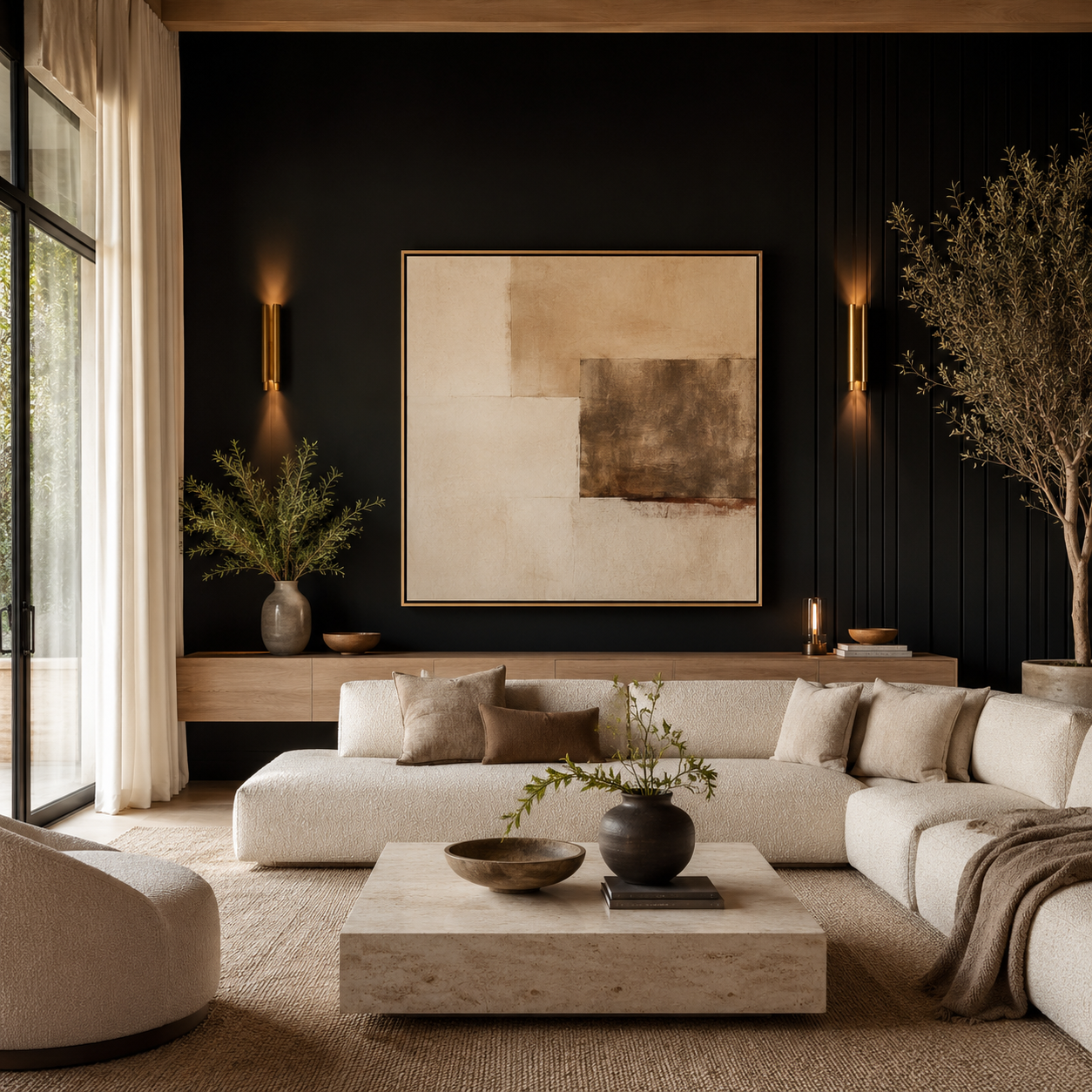
The secret lies in understanding how black interacts with natural light, furniture, wood tones, textiles, architectural details, and surrounding colors. Instead of treating black as simply another paint choice, successful interiors use it as a visual anchor. 🖤 A thoughtfully designed black wall can make warm wood appear richer, white furniture look brighter, metallic accents feel more refined, and artwork stand out dramatically.
Modern homes are also moving away from completely neutral beige and white interiors toward rooms with stronger contrast and personality. Black provides exactly that contrast while remaining timeless. Unlike highly saturated trend colors that may quickly feel dated, black works beautifully with contemporary, minimalist, rustic, industrial, Scandinavian, Japandi, traditional, and even romantic interiors.
The most impressive rooms do not simply paint one random wall black. They strategically combine color, texture, lighting, furniture placement, and architectural features. These Top 3 Black Accent Walls ideas demonstrate three very different ways to introduce black while keeping a room warm, balanced, and visually sophisticated.
Why Black Accent Walls Can Completely Transform a Room
A black wall instantly changes how the eye perceives space. Lighter colors tend to visually advance toward the viewer, while darker colors often create an impression of depth. Because of this optical effect, a carefully positioned black wall can sometimes make a room appear deeper rather than smaller.
This is particularly effective when the black wall is placed at the far end of a room. The dark surface creates a strong visual destination, encouraging the eye to travel through the space.
Contrast is another major reason black works so beautifully in interior design. 🤍 Cream upholstery, pale oak furniture, linen curtains, white ceramics, and natural stone become much more noticeable against a dark background.
Even simple furniture can appear more expensive when framed by a sophisticated black wall.
Texture becomes equally important. Flat black paint creates a very different atmosphere from black limewash, charcoal plaster, dark wood paneling, or vertical slatted walls. Each surface reflects light differently and can dramatically change the character of the room.
A smooth matte wall feels minimal and architectural.
Textured plaster feels organic and atmospheric.
Dark wood paneling creates warmth and luxury.
Vertical battens introduce rhythm and architectural detail.
Choosing the correct treatment depends on the style of the room and the atmosphere you want to create.
Choosing the Perfect Black for Your Accent Wall
Not every black paint color looks the same once it is applied to a wall. Some blacks contain blue undertones, others contain brown, charcoal, green, or even subtle violet undertones.
This difference becomes especially noticeable throughout the day.
A cool black can appear crisp and contemporary in bright daylight but may feel slightly cold in an interior dominated by cool artificial lighting. A warmer black containing brown or charcoal undertones tends to work beautifully with oak floors, beige furniture, brass fixtures, and warm lighting.
Pure black creates the most dramatic contrast.
Charcoal black is slightly softer and often easier to use.
Warm black works particularly well with natural materials.
Blue black creates a sophisticated contemporary mood.
Green black can feel botanical and organic when paired with plants and timber.
Before committing to a color, test a large sample directly on the wall. Observe it during morning light, afternoon light, and evening artificial lighting.
Small paint swatches rarely reveal the full effect of a dark color because surrounding white walls can influence how the sample appears.
Black Accent Walls Color and Material Pairing Guide
| Black Wall Style | Best Complementary Materials | Ideal Accent Colors | Overall Mood |
|---|---|---|---|
| Matte Pure Black | White oak, linen, marble | Ivory, beige, brass | Modern and dramatic |
| Warm Charcoal | Walnut, travertine, wool | Camel, taupe, cream | Cozy and sophisticated |
| Black Wood Paneling | Oak, leather, stone | Brown, bronze, olive | Luxurious and architectural |
| Textured Black Plaster | Limestone, linen, ceramics | Sand, greige, muted green | Organic and refined |
| Blue Black | Chrome, glass, pale wood | White, gray, navy | Contemporary and elegant |
This combination strategy prevents black from becoming visually disconnected from the rest of the interior.
Instead, the wall becomes part of a complete material palette.
🥇 Top 1 Black Accent Walls With Warm Natural Wood
One of the most beautiful ways to use Black Accent Walls is to combine them with natural wood. The relationship between deep black and warm timber creates one of the strongest contrasts in modern interior design.
Black brings structure and sophistication.
Wood introduces warmth and organic softness.
Together, these materials create interiors that feel modern without becoming cold.
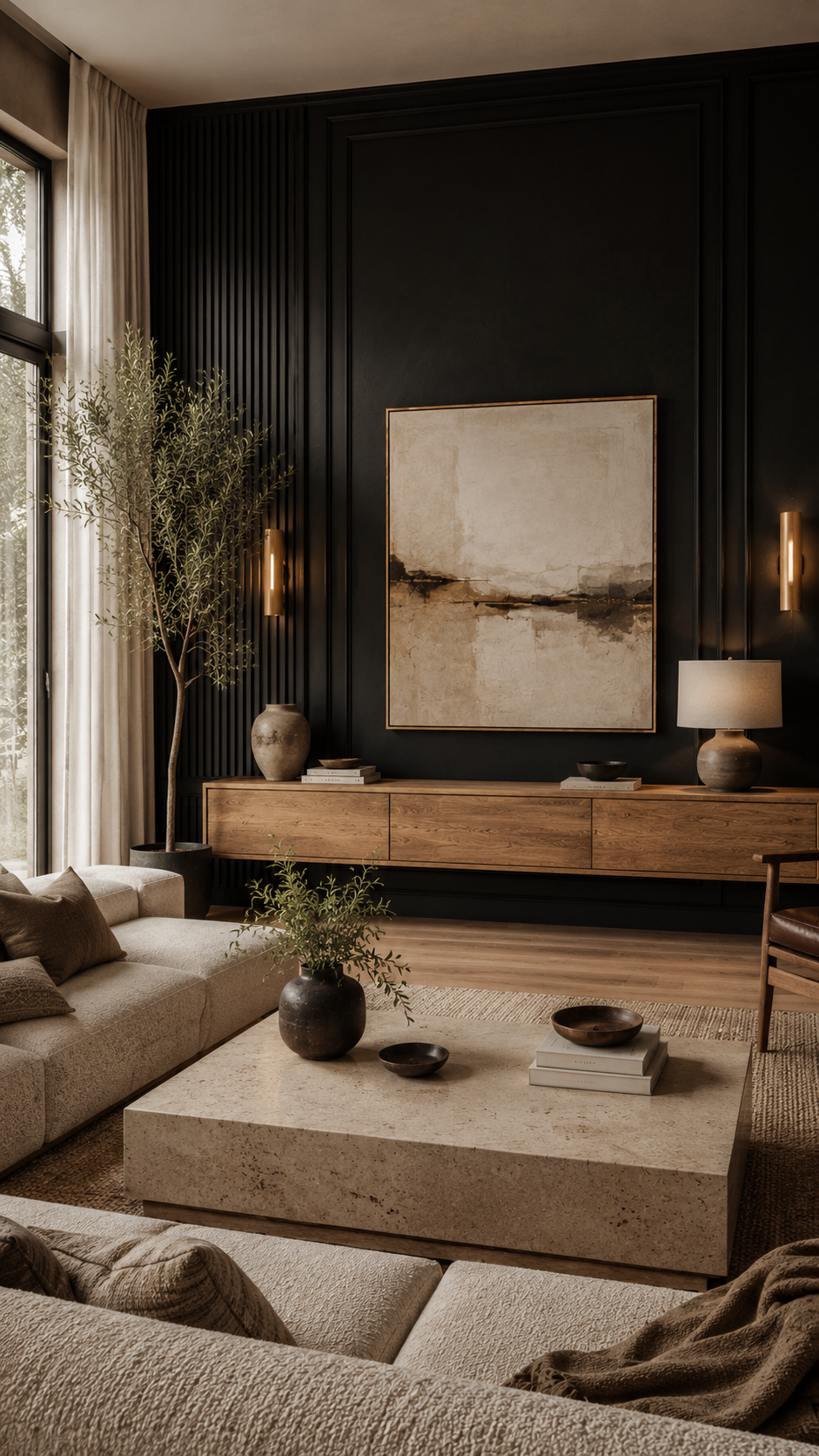
Imagine a living room with a deep charcoal wall behind a warm oatmeal sofa. A low natural oak console stretches across the wall while ceramic objects, sculptural lighting, and carefully selected artwork create subtle decorative layers.
The black background immediately makes the pale timber grain appear richer.
This approach works particularly well in modern organic, Japandi, Scandinavian, contemporary rustic, and minimalist homes.
Use Black Behind Natural Oak Furniture
Natural oak is especially effective against dark walls because its golden undertones create visual warmth.
A floating oak media console positioned against a matte black wall can instantly become the focal point of a living room. The simplicity of the furniture prevents the composition from becoming visually heavy.
Instead of covering the entire wall with decorations, allow some negative space.
The contrast itself provides much of the visual interest.
A few carefully selected accessories may be enough:
🏺 A sculptural ceramic vase
📚 Two or three oversized design books
🌿 A simple branch arrangement
🕯️ A small candle or stone object
Minimal styling allows the relationship between black and wood to remain the main design feature.
Introduce Walnut for a Richer Luxury Look
Walnut creates a darker and more sophisticated atmosphere than pale oak.
Because walnut naturally contains deep brown tones, it blends beautifully with warm black and charcoal walls. The result feels luxurious, intimate, and slightly dramatic.
A black wall behind a walnut dining table can create an impressive dining room without requiring complicated decoration.
Add cream upholstered chairs, a sculptural pendant light, and perhaps a large abstract artwork.
The contrast between dark walnut, black walls, and pale textiles produces a beautifully layered composition.
Metal finishes can further enhance this palette.
Aged brass, bronze, and antique gold work particularly well because their warm reflections prevent the dark surfaces from appearing flat.
Balance Dark Walls With Light Textiles
The biggest mistake when combining black walls with wood is making every other element dark as well.
Balance is essential.
Light linen curtains, cream sofas, beige rugs, ivory cushions, or pale upholstery introduce brightness while maintaining a sophisticated neutral palette.
Think of the black wall as the anchor.
The rest of the room should gradually become lighter as your eye moves toward furniture, textiles, and accessories.
This transition creates visual depth.
Important Note: Avoid choosing a black accent wall simply because one wall happens to be empty. The strongest results come from selecting a wall that already has architectural or visual importance such as the wall behind a bed, sofa, fireplace, television, dining table, or major artwork.
Add Warm Architectural Lighting
Lighting becomes particularly important with dark surfaces.
Instead of relying only on a central ceiling fixture, introduce several layers of light.
Wall sconces can create soft pools of illumination across the black surface.
Table lamps provide low-level warmth.
Floor lamps help illuminate corners.
Hidden LED lighting beneath cabinetry or shelving can emphasize architectural details.
The goal is not necessarily to make the black wall bright. Instead, lighting should reveal texture and create subtle highlights.
Warm white light usually produces the most inviting result, particularly when black is combined with timber.
The final space feels intimate in the evening while remaining refined during the day.
🥈 Top 2 Black Accent Walls With Architectural Paneling
Paint is not the only way to create dramatic Black Accent Walls.
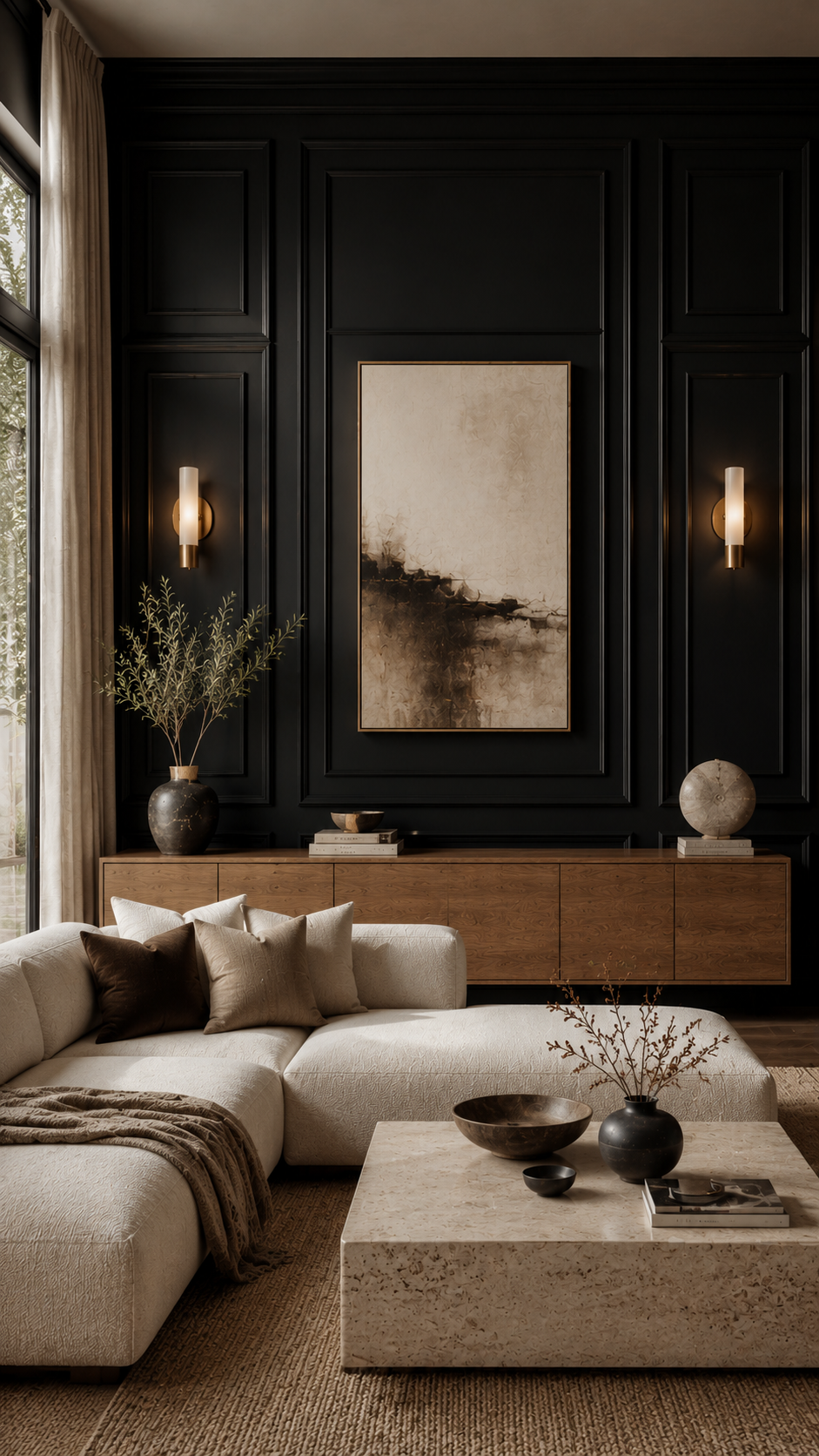
Architectural paneling can turn a dark wall into a sophisticated structural feature.
Instead of appearing like a simple color choice, the wall becomes part of the architecture.
This is one reason black paneling is increasingly popular in bedrooms, living rooms, dining spaces, home offices, and entryways.
Vertical lines introduce height.
Horizontal panels create width.
Geometric molding adds rhythm and traditional elegance.
Dark slatted wood adds texture and shadow.
Each method offers a different visual effect.
Create a Sophisticated Black Bedroom Wall
Bedrooms are particularly well suited to black architectural walls because dark colors naturally create a sense of intimacy.
A large wall behind the bed can be transformed with simple molding or vertical paneling.
Consider a deep charcoal wall with narrow rectangular molding arranged symmetrically behind a large upholstered bed.
The architectural lines create depth without requiring artwork.
An oversized headboard in oatmeal linen, mushroom bouclé, camel velvet, or warm taupe fabric can then provide softness.
Add crisp bedding with layers of cream, beige, stone, and muted brown.
The bedroom immediately feels more luxurious.
Instead of looking gloomy, the dark wall behaves almost like a frame around the bed.
Try Vertical Slatted Black Wood
Vertical timber slats are particularly effective in contemporary interiors.
When painted or stained black, the grooves between each piece of timber create small shadows throughout the day.
This subtle variation makes the wall feel dynamic.
Because the lines run vertically, the ceiling can also appear taller.
A slatted wall works beautifully behind a television because the texture provides visual interest without distracting from the screen.
For a more refined look, combine sections of black slats with smooth plaster or natural wood.
For example, a television could sit against black vertical paneling while a floating oak console introduces warmth below.
The combination feels architectural rather than decorative.
Use Black Wall Molding for Modern Traditional Interiors
Black is not limited to contemporary homes.
Traditional wall molding painted in deep charcoal can create one of the most elegant versions of a dark accent wall.
Picture-frame molding, panel molding, or subtle wainscoting adds depth that becomes particularly visible when light moves across the surface.
This style works beautifully in dining rooms.
A long dining table positioned against a black paneled wall creates a formal focal point without feeling overly traditional.
Add upholstered dining chairs, a warm wood table, linen curtains, and a sculptural chandelier.
The black wall makes classical architectural details feel more contemporary.
Artwork can also be incorporated inside the molding.
Large abstract paintings with cream, rust, beige, or muted green tones become especially striking against the dark surface.
Incorporate Floating Shelves Carefully
Black accent walls often make an excellent background for shelving.
However, restraint is important.
Too many shelves filled with small decorative items can turn a sophisticated dark wall into a cluttered display.
Instead, consider one or two long floating shelves.
Natural oak shelves against black create a beautiful horizontal contrast.
Style them with larger objects rather than many tiny accessories.
A ceramic vase, framed artwork, stacked books, and a trailing plant may be enough.
🌿 Green foliage looks particularly vibrant against black because the wall makes natural colors appear more saturated.
Plants such as olive trees, rubber plants, philodendrons, or large sculptural branches can add softness to highly architectural rooms.
🥉 Top 3 Black Accent Walls With Stone and Soft Neutral Interiors
The third approach creates perhaps the most luxurious atmosphere of all.
Black walls paired with creamy stone, soft textiles, and warm neutral furniture produce interiors that feel similar to boutique hotels and high-end architectural residences.
The key is contrast between hard and soft surfaces.
Black provides depth.
Stone introduces natural texture.
Fabric provides softness.
Warm lighting ties everything together.
This style works especially well in sophisticated living rooms, primary bedrooms, bathrooms, entryways, and dining rooms.
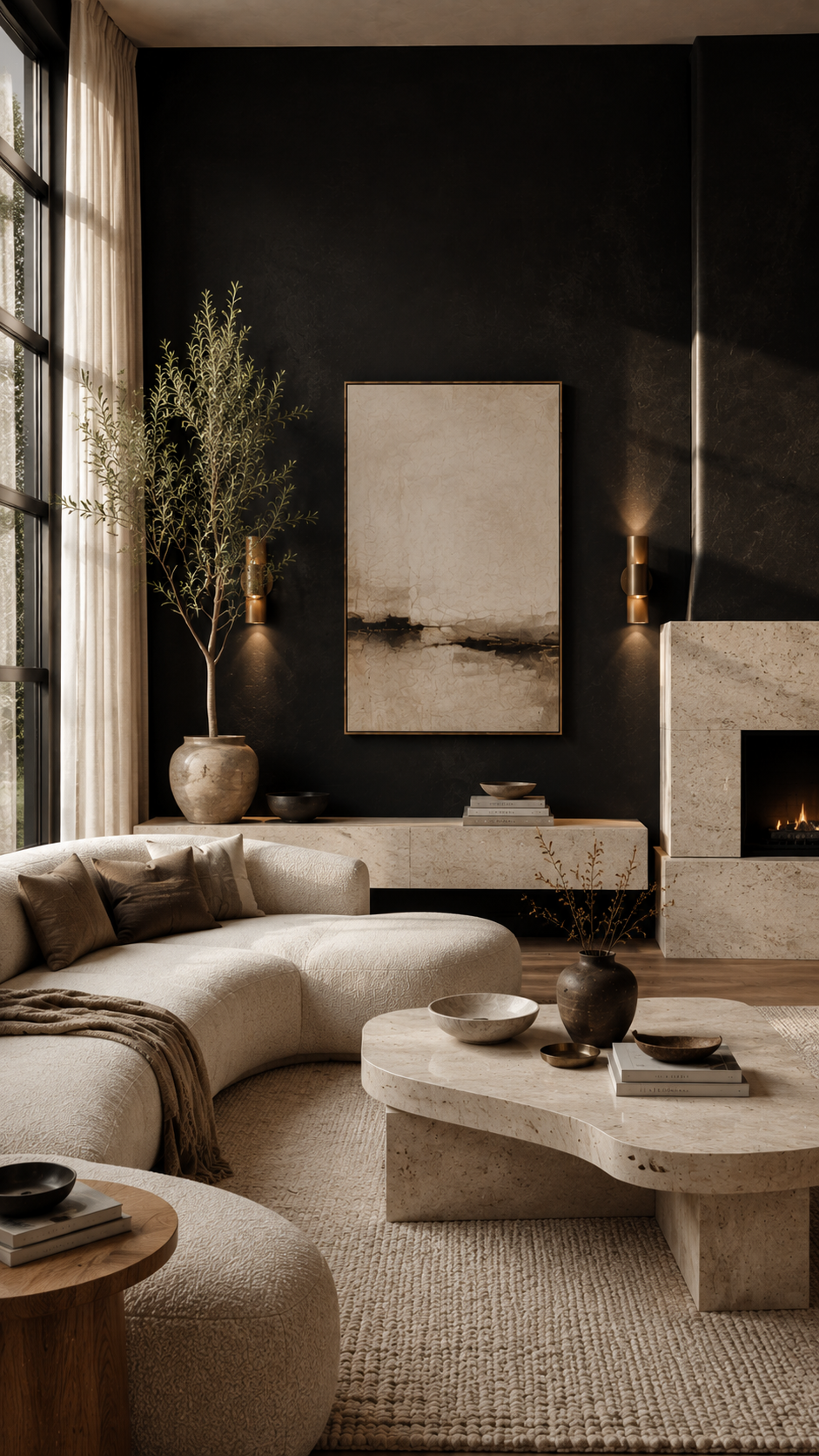
Pair Black With Travertine
Travertine has become one of the most popular materials in modern luxury interiors because of its warm cream color and visible natural pores.
Against a black wall, travertine appears almost sculptural.
A large travertine coffee table placed in front of a charcoal wall creates immediate visual contrast.
The stone’s irregular texture prevents the room from feeling overly polished.
A matching side table or console can reinforce the material palette.
The most successful compositions keep the surrounding colors restrained.
Think:
Cream
Mushroom
Warm beige
Greige
Taupe
Soft caramel
Muted olive
These shades sit comfortably between black and pale stone, creating smooth visual transitions.
Combine Black Walls With Limestone
Limestone offers a slightly softer appearance than polished marble.
Its subtle variation works beautifully in minimalist interiors.
Imagine a black plaster wall containing a simple linear fireplace surrounded by pale limestone.
The stone becomes the focal point while the black surface emphasizes its shape.
Instead of adding several decorative elements, allow the materials themselves to provide interest.
This approach reflects an important principle of sophisticated interior design.
Luxury does not always come from adding more objects.
Often it comes from using fewer materials more intentionally.
Introduce Bouclé Linen and Wool
Textiles are essential when designing rooms with large dark surfaces.
Bouclé upholstery provides softness and visual texture.
Washed linen creates relaxed elegance.
Wool rugs introduce warmth underfoot.
Combining these fabrics with black walls helps balance the harder architectural elements.
A curved cream bouclé sofa against a black wall can look almost sculptural.
Add a thick wool rug and rounded stone coffee table and the room begins to feel layered without requiring strong colors.
The contrast between tactile surfaces creates visual richness.
This is especially effective in monochromatic interiors where most of the palette consists of black, ivory, beige, and brown.
Use Black Textured Plaster Instead of Flat Paint
Flat black paint creates strong graphic contrast, but textured finishes can produce a softer atmosphere.
Black limewash, mineral paint, microcement, or textured plaster contains subtle variation.
Light catches the raised areas while deeper parts remain shadowed.
From a distance, the wall may still appear black.
Up close, however, it reveals layers of charcoal, graphite, and soft gray.
This variation makes large dark surfaces feel less severe.
Textured black walls are especially effective in rooms designed around natural materials.
Travertine, oak, linen, wool, leather, and aged metal all complement the imperfect surface.
The result feels sophisticated but not overly polished.
How to Make Black Accent Walls Feel Warm Instead of Cold
Black itself is not necessarily cold.
The surrounding materials determine the atmosphere.
A black wall paired with chrome furniture, blue-gray flooring, bright white lighting, and glossy surfaces may feel cool and highly contemporary.
The same black wall combined with oak floors, beige upholstery, brass lighting, and warm lamps can feel extremely inviting.
Color temperature matters.
Choose warm neutrals rather than icy whites whenever you want a softer atmosphere.
Cream creates less aggressive contrast than pure white.
Taupe connects beautifully with charcoal.
Camel and cognac introduce richness.
Olive green creates an organic connection.
Terracotta can provide a subtle earthy accent.
Natural materials also help.
Wood is one of the easiest ways to warm up black.
Stone introduces organic variation.
Plants provide life and color.
Textiles soften visual edges.
The room should contain enough contrast to feel dynamic but enough warmth to remain comfortable.
The Best Rooms for Black Accent Walls
Almost any room can accommodate a black wall when the placement is intentional.
Living rooms are among the easiest places to experiment because the wall behind the sofa or television already acts as a natural focal point.
Bedrooms are equally effective because black creates intimacy.
Dining rooms benefit from the dramatic atmosphere, particularly when paired with warm pendant lighting.
Home offices can use black walls to create visual focus and sophistication.
Entryways can become surprisingly memorable with dark paneling and a warm wood console.
Even bathrooms can benefit from black walls, especially when combined with limestone, marble, oak cabinetry, and warm mirrors.
The size of the room is less important than many people assume.
Small rooms can actually benefit from dark walls because the boundaries become less visually obvious.
A small powder room painted almost entirely in charcoal can feel dramatically more luxurious than the same room painted plain white.
How Lighting Changes Black Accent Walls Throughout the Day
Natural light has a major influence on how black appears.
In strong sunlight, black surfaces often reveal their undertones.
Charcoal may show hints of gray.
Warm black may appear brownish.
Blue black may reveal subtle navy tones.
In lower light, those differences become less obvious and the wall appears deeper.
Rooms with large windows can usually handle stronger blacks because natural light creates contrast.
Rooms with limited daylight may benefit from softer charcoal shades or textured finishes.
Artificial lighting becomes equally important after sunset.
Warm wall sconces positioned near a textured wall can reveal subtle surface detail.
Pendant lights can create dramatic highlights.
Table lamps introduce smaller pools of illumination that make a room feel intimate.
Avoid relying exclusively on harsh overhead lighting.
Multiple smaller sources usually create a much richer atmosphere.
✨ The best dark rooms often contain several subtle lighting layers rather than one extremely bright fixture.
Common Black Accent Wall Mistakes to Avoid
One common mistake is choosing black without considering the existing flooring.
A dark wall combined with very dark flooring can sometimes create too much visual weight.
Introduce a large pale rug, lighter furniture, or natural wood to break up the darkness.
Another mistake is using too many contrasting colors.
Black is already visually powerful.
Adding bright red, strong yellow, cobalt blue, emerald green, and several other colors can quickly make the interior feel chaotic.
A restrained palette usually creates a more luxurious result.
Poor lighting is another frequent problem.
A black wall in a room with only one cold ceiling light may appear flat.
Warm layered lighting makes a dramatic difference.
Furniture placement matters as well.
The accent wall should support the composition of the room.
If the wall has no visual relationship with the bed, sofa, dining table, fireplace, television, or architectural focal point, it may feel arbitrary.
Finally, avoid overcrowding the wall.
Black naturally creates drama.
It does not always need several frames, shelves, mirrors, plants, and decorative objects.
Sometimes one large piece of art or one beautiful piece of furniture is enough.
Styling Black Accent Walls With Artwork
Artwork becomes especially powerful against black.
White and cream artwork creates strong contrast.
Earthy abstract art introduces warmth.
Metallic frames add subtle reflection.
Large-scale pieces generally work better than many small frames because black walls already contain strong visual presence.
Consider using one oversized artwork centered above a sofa or console.
Alternatively, create a restrained gallery wall using similar frames.
Wood frames soften the composition.
Black frames create a seamless look.
Brass frames introduce elegant warmth.
White mats can help smaller artwork stand out.
Photography also looks beautiful against dark walls, particularly black-and-white architectural photography.
The wall effectively becomes a gallery background.
Decorating Black Accent Walls for Different Interior Styles
Black adapts surprisingly well to different design aesthetics.
In Scandinavian interiors, combine charcoal walls with pale oak, simple furniture, white linen, and soft gray textiles.
In Japandi spaces, use warm black with low furniture, textured plaster, stone, timber, and restrained decoration.
For modern organic interiors, combine black with travertine, curved furniture, bouclé upholstery, and sculptural plants.
Industrial interiors can pair black walls with concrete, steel, reclaimed timber, and leather.
Traditional interiors benefit from black molding, brass fixtures, antique furniture, and rich wood.
Minimalist spaces can use a completely smooth black wall paired with only a few sculptural objects.
Even coastal homes can incorporate black when balanced with pale oak, woven fibers, linen, sandy neutrals, and abundant natural light.
Black is therefore less of a specific decorating style and more of a design tool.
Should You Paint One Wall or Several Walls Black
A single black wall creates the clearest focal point.
This is ideal when you want to highlight one architectural feature or furniture arrangement.
Painting multiple walls creates a more immersive atmosphere.
In bedrooms, libraries, dining rooms, or powder rooms, using black on several surfaces can create a sophisticated cocoon-like effect.
The ceiling can even be painted dark in rooms where intimacy is desirable.
However, the furniture and lighting should then provide enough contrast.
If three walls are black, consider lighter flooring, pale upholstery, warm timber, or large windows.
The goal is balance rather than following a fixed rule.
Why Black Accent Walls Continue to Feel Timeless
Interior trends constantly change.
One year may favor terracotta.
Another may emphasize sage green.
Later, chocolate brown or burgundy may dominate.
Black behaves differently because it functions almost like an architectural neutral.
It creates contrast without requiring a specific decorative theme.
Furniture can change around it.
Artwork can change.
Seasonal colors can change.
The wall can remain.
This adaptability is one reason black has remained relevant across decades of interior design.
The key is avoiding overly trend-specific styling around it.
Simple materials such as timber, stone, linen, wool, metal, and ceramics help create a timeless foundation.
Final Thoughts on the Top 3 Black Accent Walls Ideas
The most successful Black Accent Walls are not simply dark painted surfaces. They are carefully designed focal points that interact with architecture, furniture, lighting, texture, and natural materials.
🥇 Black Accent Walls with warm natural wood are ideal for creating modern interiors that feel sophisticated yet welcoming. Oak, walnut, linen, and warm lighting soften the darkness while allowing the contrast to remain dramatic.
🥈 Black Accent Walls with architectural paneling transform a simple wall into a structural design feature. Vertical battens, wall molding, slatted timber, and geometric panels introduce depth and craftsmanship while giving the room an elevated custom-built appearance.
🥉 Black Accent Walls with stone and soft neutral interiors create the most luxurious atmosphere. Travertine, limestone, bouclé, linen, wool, and textured plaster produce a refined material palette reminiscent of high-end hotels and contemporary architectural homes.
The common thread across all three approaches is balance.
Black needs light.
Darkness needs texture.
Hard architectural surfaces benefit from soft textiles.
Strong contrast becomes more comfortable when natural materials introduce warmth.
When these elements are carefully combined, black does something few other colors can achieve. It makes ordinary materials appear richer, simple furniture look more sculptural, and familiar rooms feel dramatically more intentional.
A well-designed black wall does not merely decorate a room.
It gives the entire space an identity.
Related posts:

Best 3 Apartment Laundry Room Ideas That Make Small Spaces Look Surprisingly Luxurious
Best 3 Crochet Table Decorations That Make Any Dining Table Look Beautiful and Expensive
Best 3 Fabric Ceiling Ideas That Will Make Any Room Look Stunning and Expensive
Best 3 Plastic Pumpkins Makeover Ideas That Look Surprisingly Expensive
Best 3 Bookshelf Wallpaper Ideas That Make Any Wall Look Expensive
Best 3 Wedding Photo Displays That Make Your Celebration Feel More Personal