The best fall planter ideas can completely transform a porch, patio, balcony, or front entrance without requiring a major seasonal makeover. A thoughtfully designed planter brings together autumn color, natural texture, height, and movement in one compact arrangement, making it one of the easiest ways to create a welcoming fall atmosphere around the home.
Instead of relying only on pumpkins or traditional orange chrysanthemums, modern fall planters can feel much more sophisticated. Think sculptural branches, ornamental grasses, deep burgundy foliage, muted greenery, trailing plants, decorative cabbage, dried seed heads, and carefully selected seasonal accents. 🍂 The most beautiful combinations usually mix several textures while keeping the color palette controlled and intentional.
This season, three fall planter styles stand out especially well. The first focuses on dramatic layered foliage and ornamental grasses. The second combines pumpkins, mums, and harvest textures for a fuller traditional look. The third embraces a quieter, more architectural approach using branches, grasses, and neutral colors.
Each style offers a different interpretation of autumn, making it possible to choose a planter that complements everything from a rustic farmhouse porch to a minimalist contemporary entrance.
🍁 Why Fall Planter Ideas Can Transform an Entrance So Quickly
Outdoor planters have an unusual ability to change the mood of a home almost instantly. Unlike permanent landscaping, they can be adjusted throughout the season, rearranged around an entrance, or refreshed as individual plants begin to fade.
A large planter beside a front door can visually soften architectural lines while adding warmth and color. A matching pair can make an entrance feel symmetrical and polished. Several containers grouped together can create a layered garden effect even when the surrounding space is relatively small.
Fall also provides an especially rich collection of materials for container styling. Ornamental grasses bring movement, flowering plants introduce color, branches create height, and pumpkins or gourds provide recognizable seasonal character.
The strongest arrangements usually include three visual levels: something tall, something full in the center, and something lower or trailing around the edge. 🌿 This creates depth and prevents the planter from appearing flat.
Color is equally important. Traditional oranges and yellows remain beautiful, but sophisticated combinations often incorporate burgundy, olive green, rust, cream, muted purple, bronze, and soft brown.
These darker and more natural shades tend to blend beautifully with common exterior materials such as brick, stone, timber, black doors, white siding, and warm neutral stucco.
Quick Comparison of the Top 3 Fall Planter Ideas
Before choosing a design, it helps to compare the three strongest approaches.
| Fall Planter Style | Best Features | Ideal Colors | Best Location | Overall Look |
|---|---|---|---|---|
| 🥇 Layered Grasses and Foliage | Ornamental grasses, burgundy leaves, trailing plants, sculptural height | Rust, burgundy, olive, bronze, green | Front porch or large entry | Elegant and dramatic |
| 🥈 Harvest Mums and Pumpkins | Chrysanthemums, pumpkins, cabbage, berries, seasonal texture | Orange, cream, wine red, golden yellow | Traditional porch or steps | Warm and abundant |
| 🥉 Minimalist Branch and Grass Planter | Bare branches, dried grasses, seed heads, subtle foliage | Taupe, brown, cream, muted green | Modern entrance or patio | Architectural and refined |
All three styles can work beautifully, but the final effect depends heavily on the container itself, the scale of the arrangement, and how well the colors coordinate with the surrounding architecture.
🥇 Top 1 Layered Fall Planter Ideas With Ornamental Grasses and Rich Foliage
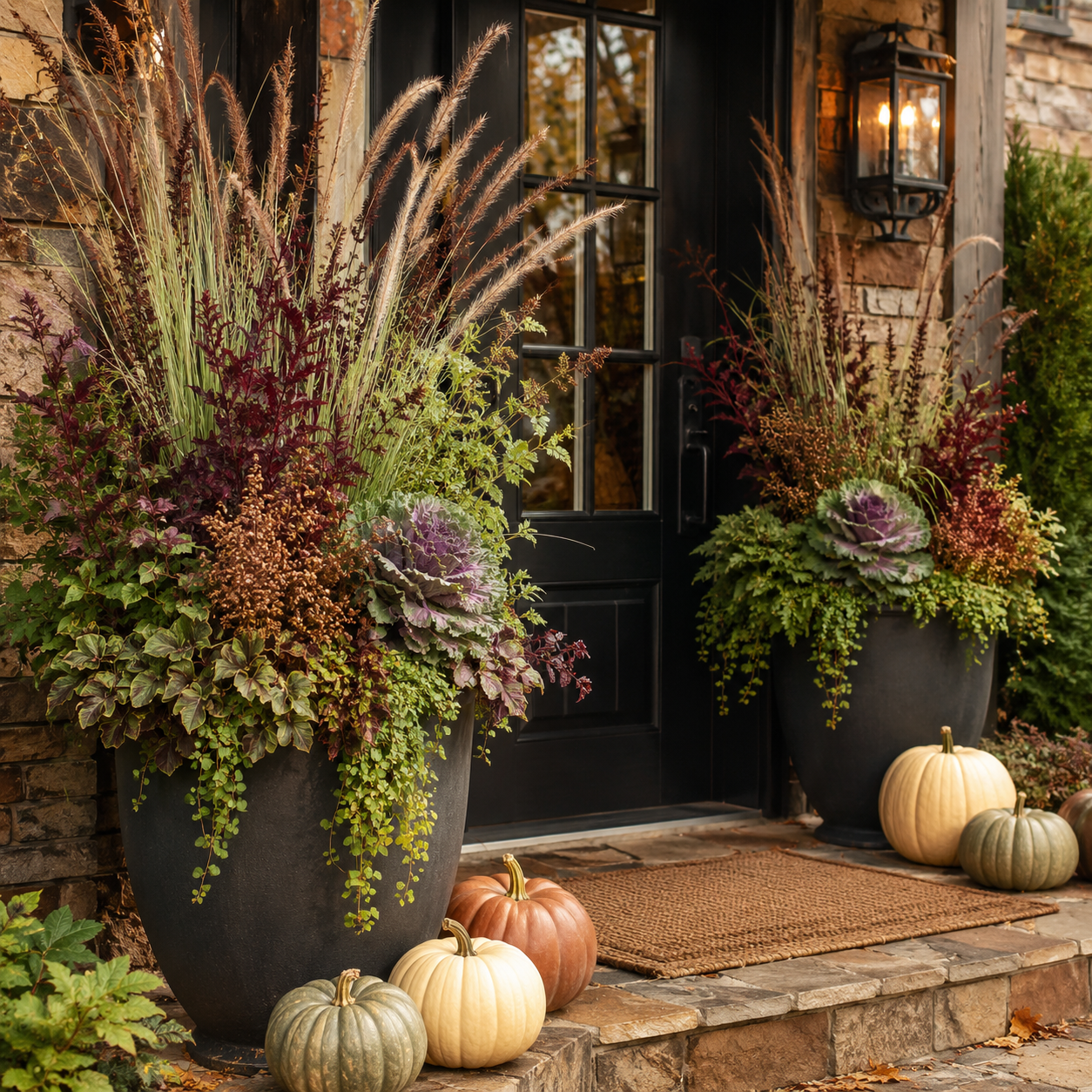
One of the most sophisticated fall planter ideas is a tall layered arrangement built around ornamental grasses and dramatic foliage.
This style works particularly well because it captures autumn without becoming overly literal. Instead of depending on pumpkins or decorative signs, the arrangement creates a seasonal feeling through natural plant color, texture, and movement.
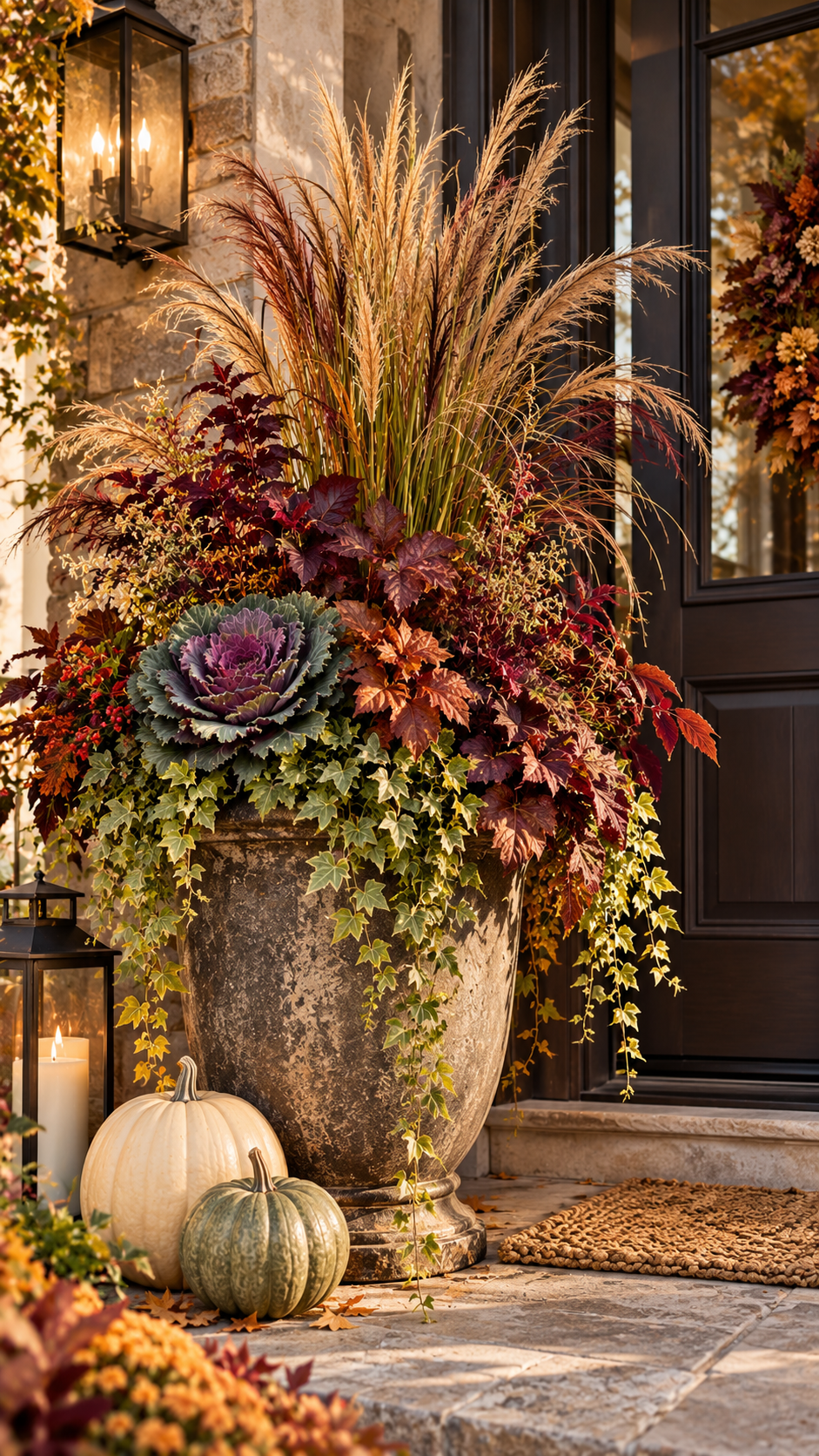
The hero element should usually be a tall ornamental grass placed toward the center or slightly behind the planter. Fountain grass, switchgrass, or another upright grass immediately introduces height and creates a graceful silhouette.
When the breeze moves through the grass, the planter feels alive rather than static. 🌾
Around the grass, add fuller plants with strong autumn colors. Deep burgundy foliage is especially effective because it creates contrast against golden grass and green leaves.
Plants with bronze, wine-red, plum, or dark purple tones can provide similar depth.
Build the Arrangement Around Height
The tallest plant should establish the structure of the planter.
In a large container, this may be an ornamental grass reaching significantly above the surrounding foliage. Tall grasses visually connect the planter to the architecture behind it and can help fill empty wall space beside a doorway.
For narrower planters, upright sedges or compact grasses can create the same effect without overwhelming the container.
A few sculptural branches can also be inserted behind the grass for additional height. Curved willow branches, dried stems, or natural twigs can make the arrangement feel even more architectural.
Avoid creating a perfectly symmetrical shape. Slight variations in height usually make the composition look more organic and professionally styled.
Add Burgundy and Bronze Foliage
Rich foliage gives this planter its autumn personality.
Instead of using flowers as the primary color source, consider plants with naturally dark leaves. Burgundy heuchera, ornamental peppers, coleus, dark-leaved sweet potato vine, and ornamental kale can all contribute to the layered effect.
Deep colors are especially useful when styling planters beside pale stone, cream siding, or light-colored doors because the contrast makes the foliage stand out.
For darker houses, balance burgundy plants with golden grasses, muted green foliage, or cream accents so that the arrangement does not disappear against the background.
The objective is not to include every autumn color. A restrained palette of approximately three or four main tones generally feels more luxurious.
For example, burgundy, olive green, bronze, and cream can create an elegant combination without relying on bright orange.
Use Trailing Plants Around the Edge
The lower edge of the planter is just as important as the center.
Trailing foliage softens the transition between the plants and the container while creating a fuller appearance. Ivy, creeping Jenny, trailing sweet potato vine, or similar cascading plants can flow gently over the rim.
These plants are particularly beautiful in tall urns or raised planters because the cascading shape becomes more noticeable.
Use trailing foliage selectively rather than covering the entire edge. Allowing portions of the planter itself to remain visible keeps the arrangement looking intentional.
A few trailing sections positioned asymmetrically often look more natural than a completely uniform ring.
Choose a Substantial Container
Because the plant arrangement is visually rich, the container should remain relatively simple.
Large matte black planters look striking with burgundy and golden foliage. Weathered stone containers create a European garden feeling. Aged terracotta introduces warmth and works especially well with rustic homes.
For contemporary spaces, tall cylindrical planters in charcoal, taupe, or warm gray can create a cleaner silhouette.
Scale matters considerably. A tiny container beside a large doorway may look insignificant even if the plants themselves are beautiful.
Whenever possible, use a planter that feels visually proportional to the entrance.
Two matching planters can also create a stronger architectural frame around a door.
Important Note: Choose plants according to the actual autumn conditions in your region. Some plants tolerate cool temperatures exceptionally well, while others may decline quickly after the first cold nights or frost.
Style the Surrounding Area Simply
When the planter itself is elaborate, surrounding decorations should remain understated.
Place one or two pumpkins nearby rather than creating an enormous pile. A simple doormat, lantern, or small seasonal wreath may be enough to complete the entrance.
This restraint allows the planter to remain the main attraction.
🍂 The final result should feel more like a miniature autumn garden than a container filled with random seasonal decorations.
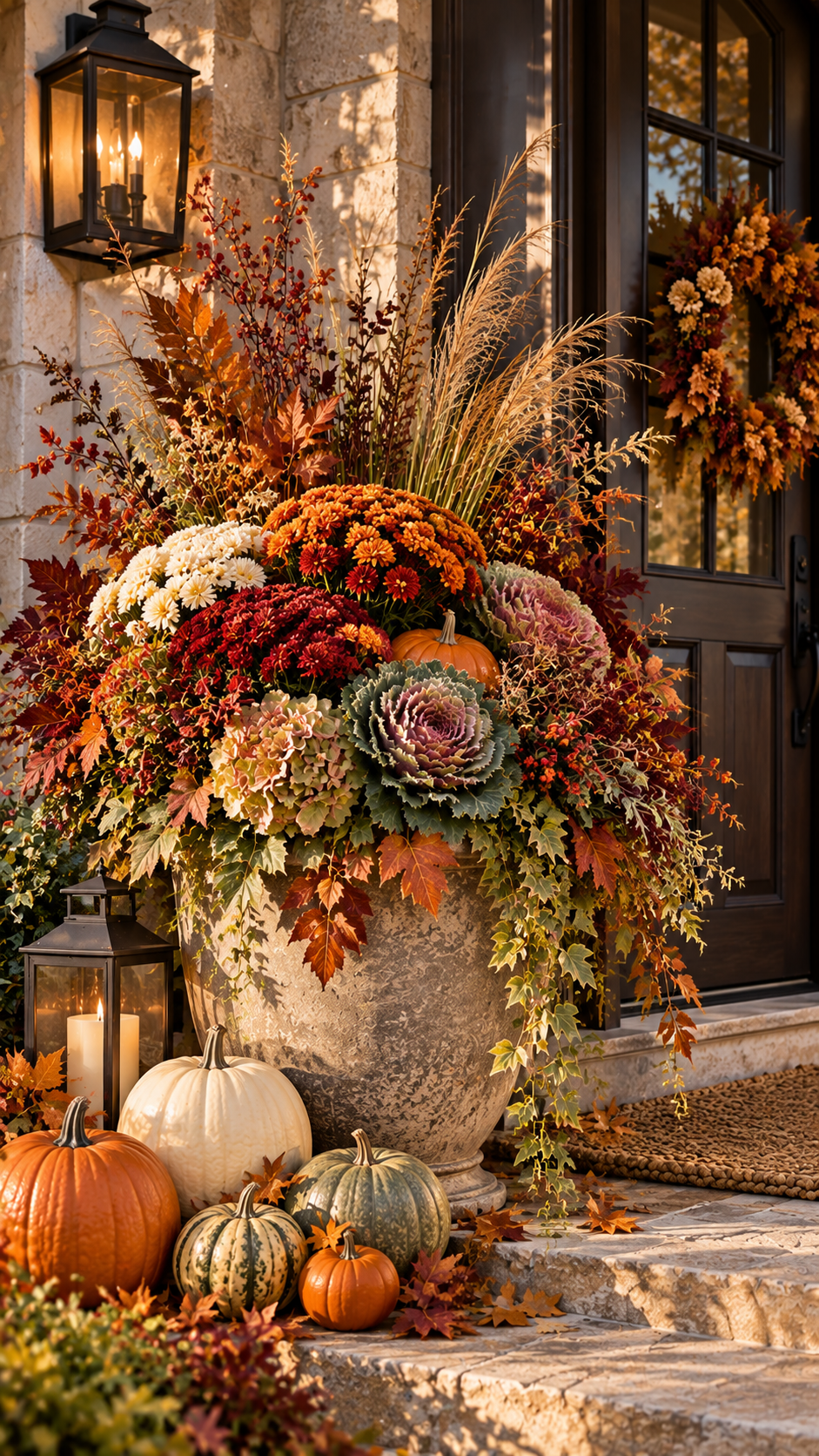
🥈 Top 2 Abundant Fall Planter Ideas With Mums Pumpkins and Harvest Texture
For those who love recognizable autumn color, an abundant harvest planter remains one of the most charming options.
This style celebrates the traditional side of the season with chrysanthemums, ornamental cabbage, pumpkins, berries, and warm-toned foliage.
The difference between an ordinary fall planter and a beautifully designed one comes down to layering.
Rather than filling the container entirely with one variety of mums, combine flowers with foliage, structural plants, and natural harvest accents.
The result feels much richer and more dimensional.
Make Chrysanthemums the Main Flower
Chrysanthemums remain a fall favorite for good reason.
Their dense clusters of flowers provide instant color and fullness, and they are widely associated with autumn porch decorating.
However, color selection can dramatically change the overall mood.
Bright orange and yellow create a cheerful traditional look. Deep burgundy or wine-colored mums feel more dramatic. Cream or pale peach varieties produce a softer, more elegant arrangement.
For a sophisticated harvest planter, consider combining two closely related shades instead of many competing colors.
Cream mums mixed with muted orange pumpkins can feel refined and warm. Burgundy flowers paired with dusty green foliage create a darker and moodier interpretation.
The flowers should appear integrated into the arrangement rather than forming one perfect round ball.
Surround them with grasses, cabbage, and trailing greenery to break up the shape.
Introduce Ornamental Cabbage and Kale
Ornamental cabbage is one of the easiest ways to add sculptural texture to autumn containers.
Its large layered leaves provide a completely different shape from delicate flowers and grasses. Colors often include sage green, purple, cream, and dusty pink, making it easy to coordinate with seasonal palettes.
Position ornamental cabbage closer to the front of the planter where the leaves can be clearly seen.
Because the plant naturally forms a broad rosette, it creates visual weight around the lower part of the arrangement.
Several smaller cabbage plants can also be used in place of one large specimen.
This approach is especially effective in wide trough-style containers or low urns.
🥬 Although cabbage contributes color, its greatest value is texture. The thick leaves create contrast against soft mums and feathery grasses.
Add Pumpkins Without Overcrowding the Container
Pumpkins can transform a fall planter into a true harvest display, but they are usually most effective when used outside the container rather than packed into the soil.
Place a few pumpkins beside the base of the planter, allowing them to visually connect with the colors above.
Small pumpkins or miniature gourds can also be nestled carefully near the front edge if the container is large enough.
White and pale green pumpkins are particularly useful for elegant arrangements because they introduce lightness.
Traditional orange pumpkins create stronger contrast and a classic seasonal feeling.
For a layered look, mix several sizes rather than using identical pumpkins.
Place the largest pumpkin closer to the planter and smaller ones slightly forward. This creates a natural visual transition from the container to the surrounding porch.
Add Berries Seed Heads and Natural Texture
The most interesting harvest planters include materials that extend beyond flowers.
Berry branches introduce small dots of color and a delicate branching structure. Seed heads add texture. Dried hydrangea or faded flowers can bring softer muted tones.
These elements also make the arrangement look more established and garden-inspired.
Instead of trimming every stem to the same height, allow selected branches or seed heads to extend above the mums.
The irregular silhouette creates movement and prevents the planter from feeling too formal.
🍁 This is particularly effective for farmhouse or cottage-style entrances where slightly imperfect arrangements often feel more authentic.
Coordinate the Planter With the Porch
Traditional autumn displays are often colorful, so visual coordination becomes especially important.
If the front door is black, navy, forest green, or natural wood, most harvest colors will work beautifully.
For red brick homes, cream, burgundy, muted green, and copper often blend more naturally than extremely bright orange.
If the house exterior is already visually busy, reduce the number of colors in the planter.
A limited palette helps the arrangement look curated rather than chaotic.
For example, a combination of cream mums, deep red foliage, green cabbage, and white pumpkins can create seasonal character without overwhelming the entrance.
🥉 Top 3 Minimalist Fall Planter Ideas With Sculptural Branches and Dried Grasses
Minimalist autumn decorating has become increasingly attractive because it focuses on shape, texture, and natural materials rather than large amounts of seasonal ornament.
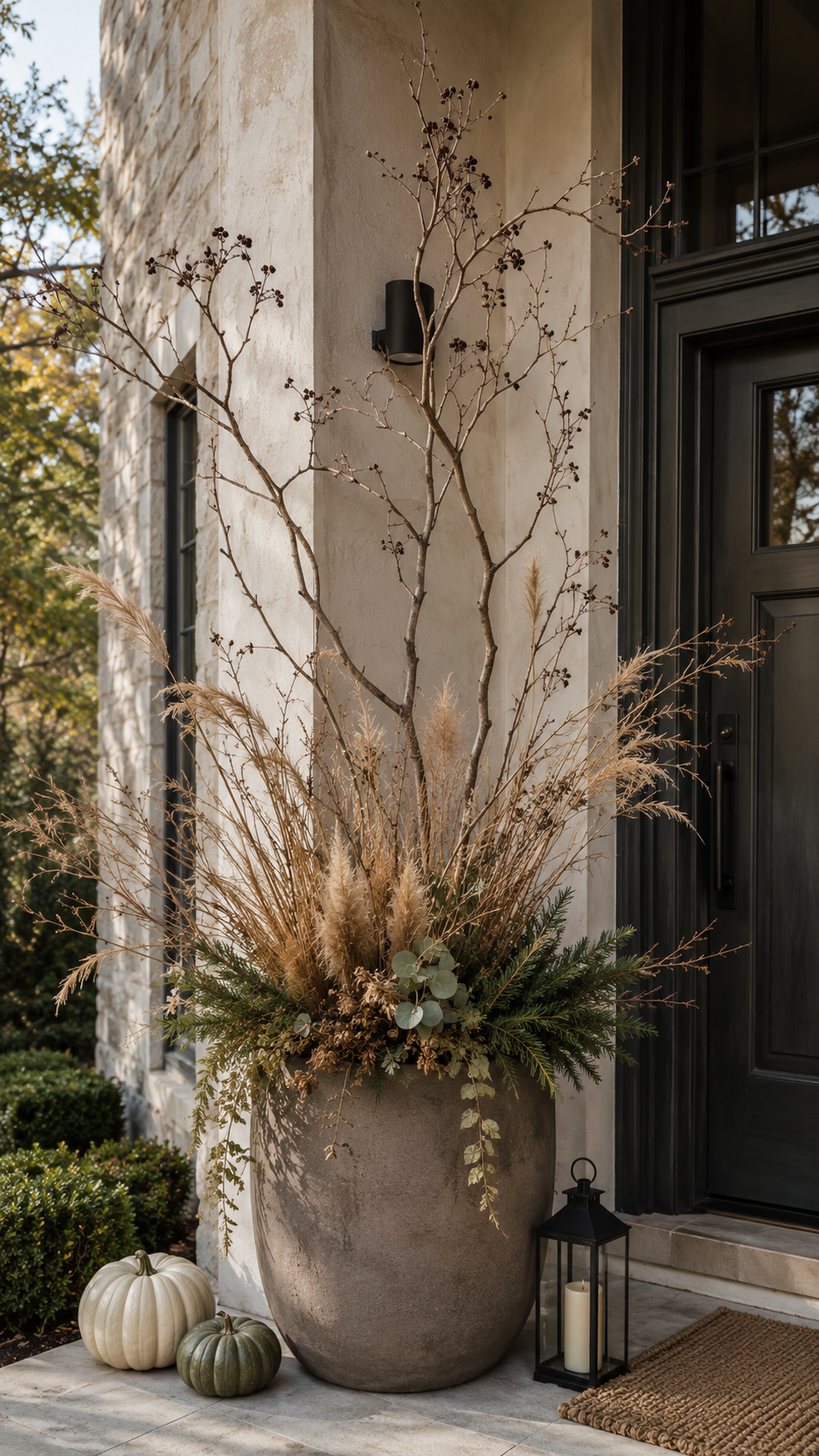
A sculptural branch planter can be extremely simple while still creating dramatic visual impact.
This style is particularly suitable for modern homes, Scandinavian-inspired spaces, neutral porches, apartment balconies, and architectural entrances.
The arrangement typically begins with a large container and a group of tall natural branches.
Instead of filling every empty space, the design intentionally allows open areas between stems.
That negative space gives the planter a lighter, more artistic appearance.
Start With Strong Sculptural Branches
Branches create the main architecture of this arrangement.
Choose stems with attractive natural curves, smaller branching details, or subtle remaining leaves.
They can be arranged vertically for a clean modern look or allowed to spread outward for something more organic.
Height is important.
A branch arrangement should generally extend well above the planter so that the overall composition feels confident and intentional.
Small twigs placed inside a large outdoor urn often look unfinished.
Using fewer but larger branches creates a much stronger effect.
Birch branches can provide pale neutral color. Dark natural branches produce a more dramatic silhouette. Branches with rust-colored leaves create an obvious autumn connection.
The choice depends on the surrounding architecture.
Layer in Dried Ornamental Grasses
Dried grasses soften the hard structure created by branches.
Pampas-style plumes, dried fountain grass, wheat-like stems, and other ornamental grasses can create subtle movement and golden autumn tones.
Arrange them around the base of the branches but avoid placing them evenly.
Some stems should sit slightly higher while others should lean gently outward.
The arrangement should feel loose without appearing messy.
🌾 Mixing two grass textures can work beautifully. One may be tall and feathery while another is shorter and more structured.
This variation creates depth even when the overall color palette remains neutral.
Use Muted Greenery Sparingly
Minimalist does not necessarily mean completely dried.
Small amounts of muted greenery can keep the planter connected to the surrounding landscape.
Eucalyptus-style foliage, olive-toned leaves, evergreen cuttings, or subtle trailing greenery can all work well.
The key is restraint.
Instead of filling the entire container with green foliage, allow individual stems to appear between branches and grasses.
This approach makes each texture easier to appreciate.
Muted green also provides a useful transition between beige grasses and dark branches.
Choose Neutral Containers
The container plays a particularly important role in minimalist styling because fewer plants mean more of the pot remains visible.
Consider stone, concrete, matte ceramic, aged terracotta, or simple metal planters.
Warm gray and taupe containers create a sophisticated neutral appearance.
Black containers provide strong contrast, especially against pale exterior walls.
Natural terracotta works beautifully when the surrounding architecture includes wood or warm brick.
For a luxury contemporary effect, oversized rounded containers or tall architectural planters can become decorative objects themselves.
Avoid overly ornate patterns unless the exterior architecture already supports a traditional style.
Let Texture Replace Bright Color
One of the most appealing characteristics of minimalist fall planters is their ability to communicate the season without using obvious autumn orange.
A palette of warm brown, faded green, oat beige, mushroom gray, and cream can still feel unmistakably autumnal.
Texture does most of the work.
Rough branches contrast with soft grass plumes. Smooth ceramic contrasts with dried leaves. Fine seed heads contrast with larger stems.
These subtle variations become much more noticeable when bright colors are removed.
The result is quiet, natural, and highly versatile.
🍂 How to Choose the Best Fall Planter Ideas for Your Home
Choosing between the three styles should begin with the architecture rather than the plants.
A traditional cottage or farmhouse can naturally support abundant harvest planters filled with mums and pumpkins.
A contemporary house may look more harmonious with sculptural branches and restrained grasses.
Homes that fall somewhere in between often work beautifully with layered ornamental grasses and dark foliage.
Consider the color of the front door as well.
A black door provides a strong neutral background for almost every fall palette. Natural wood pairs beautifully with rust, olive, cream, and burgundy. White doors can benefit from deeper foliage that creates visible contrast.
The size of the surrounding area also matters.
Large front steps can support multiple planters and pumpkins without appearing crowded. Small porches may look better with one carefully designed focal planter.
When space is limited, vertical arrangements are especially useful because they create visual impact without requiring much floor area.
Think in Terms of Thriller Filler and Spiller
A classic container design technique remains useful for fall arrangements.
The thriller is the tallest or most dramatic element, such as ornamental grass or sculptural branches.
The filler creates fullness in the middle, including mums, foliage, cabbage, or compact grasses.
The spiller falls over the edge, such as ivy or another trailing plant.
Not every planter needs all three components, particularly minimalist arrangements, but the principle helps create visual hierarchy.
When something is tall, something is full, and something softens the edge, the planter usually feels more complete.
Repeat Colors From the Surrounding Home
One simple way to create a professionally styled entrance is to repeat existing colors.
If the front door includes warm wood, add terracotta or rust. If the house features charcoal accents, consider a black planter or dark foliage.
If the exterior includes pale limestone, incorporate cream pumpkins or soft beige grasses.
Repeating colors creates visual continuity.
The fall decorations appear connected to the architecture rather than temporarily placed in front of it.
🌿 How to Make Fall Planters Look Fuller and More Expensive
Luxury-looking seasonal arrangements are usually defined by scale and layering rather than the price of individual plants.
A larger container often creates more impact than several tiny pots scattered around the porch.
Start with a strong central element and build outward.
Do not place every plant at exactly the same height. Variation is necessary to create depth.
Mix fine textures with broad leaves. Combine upright forms with cascading ones. Allow some stems to extend beyond the expected outline of the planter.
This gives the arrangement a more natural designer-quality appearance.
Another useful technique is repetition.
If using two planters near the entrance, repeat several key plants in both arrangements rather than making them completely different.
They do not need to be identical, but repeating grasses, foliage colors, or trailing plants creates harmony.
Natural imperfections also help.
A perfectly symmetrical planter can sometimes appear artificial. Slightly uneven branch placement or foliage extending farther on one side can create a more relaxed, garden-inspired composition.
🏡 Simple Ways to Style Fall Planters Around the Front Door
Once the planter is finished, a few surrounding details can help complete the entrance.
Place pumpkins at different heights near the container rather than lining them up perfectly.
A lantern can introduce another vertical element, particularly beside lower planters.
Natural doormats, simple wreaths, wooden benches, and woven baskets can also reinforce the seasonal atmosphere.
However, avoid adding too many competing decorations.
The strongest fall entrances usually have one clear focal point.
If the planter is highly detailed, keep the wreath simple. If the doorway already includes a dramatic garland, choose quieter planters.
Visual balance is more important than the total number of decorations.
🍁 Autumn decorating feels most sophisticated when the natural materials appear to belong together.
🍂 Final Thoughts on the Best Fall Planter Ideas
The most beautiful fall planter ideas do much more than place seasonal flowers beside the front door. They combine proportion, color, movement, and natural texture to create an intentional extension of the home.
For a dramatic and sophisticated entrance, 🥇 layered ornamental grasses with burgundy foliage offer the strongest combination of height, texture, and modern autumn color.
For a warm and recognizable seasonal display, 🥈 mums, ornamental cabbage, pumpkins, and harvest accents bring classic fall charm while still allowing plenty of creative variation.
For a calmer and more architectural look, 🥉 sculptural branches with dried grasses and muted greenery prove that autumn decorating does not need bright colors or excessive ornament.
The best choice ultimately depends on the style of the home and the atmosphere being created.
A rustic entrance may benefit from overflowing harvest color. A modern doorway may look more impressive with one oversized minimalist container. A transitional home can easily combine dark foliage, ornamental grass, and subtle seasonal accents.
Whichever style is chosen, focus on scale, layering, and a controlled color palette. 🌾 A carefully designed fall planter can become the central feature of an entrance, bringing warmth and seasonal personality to the home from the first days of autumn through the colder weeks ahead.
Related posts:

Best 3 Floral Painted Pumpkin Ideas That Will Make Your Fall Decor Look Absolutely Stunning
Best 3 October Dry Erase Calendar Ideas That Make Your Fall Home Look Beautiful and Organized
Top 3 90s Fall Decor Ideas That Make Your Home Feel Warm Nostalgic and Expensive
Top 3 Dollar Tree Stacking Pumpkins Ideas That Look Shockingly Expensive
Top 3 Fall Bathroom Decor Ideas That Make Your Space Look Expensive
Top 3 Fall Dough Bowl Ideas That Make Your Home Look Effortlessly Cozy