
Halloween decorations do not always need giant skeletons, expensive inflatable figures, or an entire porch filled with pumpkins. One of the most dramatic seasonal transformations can happen on something already built into your home: the windows. With the right halloween window painting idea, an ordinary pane of glass can become a haunted silhouette, a glowing piece of spooky stained glass, or a mysterious apothecary display that completely changes the atmosphere of a room.
The appeal is especially strong because painted windows work from both sides. During the day, sunlight reveals color, texture, and tiny painted details. At night, interior lamps transform the artwork into a glowing Halloween feature that can be seen from the street. 🎃 This makes window painting particularly useful for apartments, smaller homes, front porches, shops, classrooms, and anyone who wants high visual impact without storing bulky decorations after October.
The best designs are not necessarily the most complicated ones. A successful Halloween window usually relies on one strong visual story, a controlled color palette, and enough empty glass to keep the artwork readable. Instead of covering every centimeter with random bats, ghosts, pumpkins, and cobwebs, a carefully planned composition can look much more stylish.
Below are three standout halloween window painting concepts that feel atmospheric, creative, and surprisingly achievable. Each creates a different Halloween mood, from elegant haunted-house drama to colorful vintage glass and mysterious potion-shop charm.
Why Halloween Window Painting Creates So Much Visual Impact
Windows are naturally framed surfaces, which makes them surprisingly similar to giant pieces of artwork. The surrounding trim creates a built-in border, while the glass itself can interact with daylight, reflections, indoor lighting, and the outdoor environment.
That layered effect gives window paintings a visual quality that ordinary wall decorations cannot easily reproduce. A black painted tree branch, for example, might appear graphic and simple during the afternoon but become a dramatic silhouette after sunset when warm light shines behind it.
Another advantage is flexibility. 🕸️ Halloween window painting can be playful, spooky, sophisticated, vintage, gothic, whimsical, or minimalist depending on the design. A household with children might prefer smiling ghosts and candy-inspired colors, while someone decorating a modern home might choose black silhouettes, muted cream, smoky burgundy, and amber.
Window art can also connect interior and exterior Halloween decorating. A painted moon can visually align with pumpkins placed beneath the window. Painted branches can echo real branches used in an outdoor arrangement. A mysterious apothecary painting can coordinate with candles, bottles, books, and dried botanicals inside the room.
The most convincing results usually come from treating the window as a complete scene rather than as a surface for isolated stickers or drawings.
Important Note: Always use paint specifically suitable for temporary glass decoration if you plan to remove the design later. Test a small hidden section first, and avoid painting seals, window mechanisms, damaged glass, or surfaces where the manufacturer advises against coatings.
Quick Comparison of the Top 3 Halloween Window Painting Ideas
Each of these designs produces a very different effect, so the best choice depends on the mood of the house, the size of the window, and how much detail you want to paint.
| Halloween Window Painting Idea | Overall Mood | Best Colors | Difficulty | Best Feature |
|---|---|---|---|---|
| Haunted Silhouette Story Window | Gothic cinematic mysterious | Black charcoal cream amber | Easy to Medium | Looks dramatic from the street |
| Ghostly Stained Glass Window | Artistic colorful vintage | Burgundy amber violet smoky blue cream | Medium | Beautiful in daylight and backlighting |
| Midnight Apothecary Window | Magical mysterious old world | Black olive plum amber gold | Medium | Creates a layered potion shop illusion |
All three approaches can be adapted for large picture windows, narrow entry windows, kitchen windows, apartment windows, or smaller panes divided by frames.
The key difference is how they use the glass. The first relies mainly on strong silhouettes. The second treats the window almost like decorative stained glass. The third creates an illustrated world filled with bottles, labels, shelves, and magical details.
🥇 Best 1 Halloween Window Painting With a Haunted Silhouette Story
A halloween window painting built around silhouettes is one of the easiest ways to achieve a large, dramatic result without requiring advanced painting skills.
Instead of painting many tiny realistic objects, the concept uses recognizable shapes such as twisted trees, ravens, crooked rooftops, crescent moons, flying bats, iron gates, and distant figures. These forms are immediately readable even when viewed from across the street.
The strongest version feels like a single cinematic scene rather than a collection of Halloween symbols.


Create One Continuous Haunted Landscape
Start by imagining the lower part of the window as the ground line of a mysterious landscape.
A dark hill can gently rise from one side of the glass. A crooked old house might sit near the highest point, while a twisted tree stretches its branches diagonally across the opposite side. This creates movement and prevents the scene from feeling too symmetrical.
Behind the house, paint a large pale moon using creamy white, muted yellow, or soft amber. 🌕 The moon becomes the main visual focal point while the darker shapes remain secondary.
Several tiny bats can travel across the moon or disappear toward the upper corner of the window. Keep them different sizes so the scene has depth.
One or two larger foreground elements can make the composition even stronger. A black fence, bare branch, perched raven, or old gate can appear along the bottom edge of the glass.
Keep the Color Palette Surprisingly Limited
Halloween decorations often become visually cluttered because too many colors are used at once.
For this design, restraint makes the window look more sophisticated.
Use black or charcoal for the majority of the silhouette work. Add cream or pale amber for the moon. A small amount of burgundy, muted orange, or smoky purple can be used for selected details.
The background does not need to be completely painted. In fact, leaving large sections of clear glass creates contrast and allows reflections from outside to become part of the composition.
During daylight, the design feels graphic and artistic.
At night, the entire effect changes.
A warm lamp inside the room creates illumination behind the shapes, making the window resemble a giant Halloween lantern. 🕯️
Add Tiny Storytelling Details
The design becomes much more memorable when viewers notice small details after looking closely.
For example, one tiny upstairs window in the painted haunted house could glow warm yellow.
A cat silhouette could sit on the fence.
A small figure carrying a lantern might stand beneath the tree.
A raven could perch near the moon.
A narrow trail could wind toward the house.
These details suggest a story without explaining everything. That sense of mystery is what makes the image interesting.
Avoid filling every empty space. Negative space is essential because it makes the main silhouettes easier to understand.
Use Window Frames as Part of the Design
If the window is divided into several panes, do not automatically treat those divisions as obstacles.
They can actually improve the artwork.
A large moon could occupy one pane while tree branches extend across neighboring sections. A haunted house can sit below the central frame, creating the illusion that the architecture continues behind the window structure.
For tall windows, emphasize vertical elements such as tall trees, towers, or elongated branches.
For wide windows, create a horizontal landscape with several layers of hills and distant scenery.
This flexibility makes silhouette painting especially useful for unusual window shapes.
Make the Nighttime View the Final Test
After finishing the design, evaluate it from outside after dark.
Turn on the lamps inside the room and step far enough away to see the entire window.
Small details that looked important while painting may disappear from a distance, while large shapes become much stronger.
If necessary, strengthen a few important outlines or increase the size of key objects.
The final image should remain recognizable even when viewed quickly from the sidewalk or driveway.
That instant readability is what gives this halloween window painting concept such powerful curb appeal.
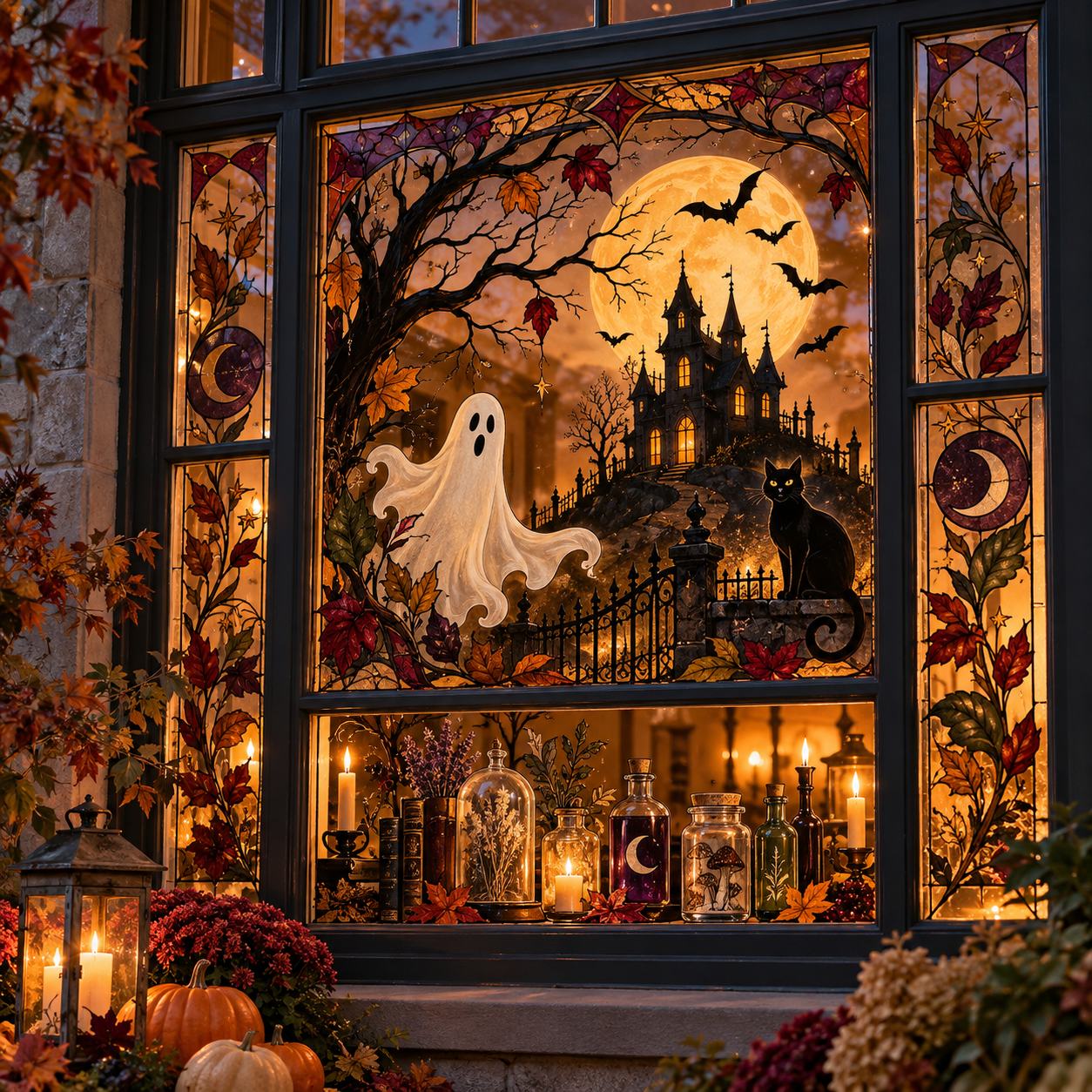
🥈 Best 2 Halloween Window Painting With Ghostly Stained Glass Panels
The second idea transforms the glass into something inspired by old stained-glass windows, but with a playful Halloween personality.
Instead of creating realistic medieval stained glass, the goal is to use bold black outlines and translucent-looking areas of color to divide the window into decorative illustrated sections.
The finished result can feel vintage, whimsical, artistic, and slightly gothic all at once. 👻

Build the Halloween Window Painting Around One Central Character
Choose one recognizable central subject.
A friendly sheet ghost works beautifully because the simple white form immediately stands out against darker surrounding colors.
Other possibilities include a black cat sitting beneath a crescent moon, an elegant pumpkin with curling vines, a raven surrounded by stars, or a vintage witch hat framed with botanical details.
Keep the central figure larger than everything else.
The surrounding sections should support the subject rather than compete with it.
For example, a large ghost could occupy the center while decorative panels around it contain tiny moons, stars, bats, spiderweb patterns, or stylized autumn leaves.
This creates a structured composition similar to an illustrated storybook window.
Use Thick Dark Lines to Create the Stained Glass Illusion
The characteristic appearance of stained glass comes largely from strong divisions between colors.
Paint bold black, charcoal, or deep brown lines around major shapes.
These lines should look intentional and consistent rather than shaky or overly delicate.
Curved lines can divide the background into decorative sections. Avoid creating too many tiny compartments because the design can quickly become busy.
Large geometric sections are easier to paint and more visible from a distance.
Try combinations of arches, diamonds, elongated curves, circles, and irregular botanical shapes.
The window frame itself can visually become part of this structure.
Choose Moody Halloween Jewel Tones
This is where the concept becomes especially beautiful.
Rather than relying only on bright orange and black, use a more sophisticated jewel-toned palette.
Consider:
- deep burgundy
- smoky violet
- warm amber
- muted pumpkin
- midnight blue
- dark forest green
- ivory
- dusty rose
- antique gold accents
These colors still communicate autumn and Halloween, but the overall result feels more decorative and mature.
🍂 Amber areas look particularly attractive when sunlight passes through them during the afternoon.
Deep purple and burgundy sections become dramatic after sunset.
Cream or pale ivory can prevent the overall window from becoming too dark.
Introduce Vintage Halloween Motifs
Small decorative symbols make the design feel richer.
Think less about modern cartoon Halloween graphics and more about old illustrated postcards, vintage Halloween party invitations, and antique seasonal decorations.
Use tiny stars with irregular points.
Add crescent moons with faces.
Paint curling pumpkin vines.
Include simple black cats with arched backs.
Create tiny candle flames, moths, ravens, keys, or miniature lanterns.
These elements add personality without requiring photorealistic painting.
The artwork should feel handmade and slightly imperfect. That quality actually supports the vintage look.
Create Repetition Across Multiple Window Panes
This concept works particularly well when the home has several similar front windows.
Instead of painting identical scenes, create coordinated variations.
One window might feature a ghost.
Another could feature a black cat.
A third could display a crescent moon surrounded by stars.
Keep the same outline style and color palette across every window so the group feels intentional.
From outside, the windows will resemble a collection of illuminated seasonal panels.
This can produce an especially striking effect on porches, enclosed patios, sunrooms, and homes with multiple street-facing windows.
Combine Painting With Interior Lighting
Lighting can completely change how the painted colors appear.
Warm lighting behind the window enhances burgundy, amber, gold, and cream tones. Cooler light can intensify violet and midnight-blue areas.
Small battery candles or warm table lamps placed several feet behind the glass can create an atmospheric glow without visually blocking the painting.
Avoid placing too many decorations directly on the windowsill. The painted glass should remain the hero.
A few carefully selected pumpkins or candlesticks are enough.
This combination turns the design into something that feels equally decorative from inside and outside the home.
🥉 Best 3 Halloween Window Painting With a Midnight Apothecary Scene
For anyone who prefers mysterious Halloween decorating over classic haunted-house imagery, a magical apothecary window offers a completely different direction.
Imagine the window becoming the front display of an old potion shop that appears only after midnight.
Shelves filled with strange bottles, dried herbs, glowing liquids, handwritten labels, candles, moons, and unusual botanical ingredients create a design that rewards closer inspection. 🧪
This concept works especially well for kitchen windows, dining rooms, home offices, entryways, and any space where a slightly more elegant Halloween atmosphere feels appropriate.

Paint the Illusion of Old Wooden Shelves
Begin with two or three horizontal painted shelves.
They do not need complicated perspective.
Simple dark lines with slightly irregular edges are enough to suggest aged wood.
Leave generous spacing between each shelf so the objects remain readable.
The lower shelf can contain larger potion bottles.
The middle shelf might display jars, books, candles, and botanical ingredients.
The upper section can be more open, perhaps featuring hanging herbs, a crescent moon, stars, or a mysterious painted sign.
The result should resemble a magical shop window rather than a crowded kitchen cabinet.
Create Distinctive Potion Bottles
Bottles are the visual stars of this idea.
Use different silhouettes:
- tall narrow bottles
- round potion flasks
- tiny corked jars
- square medicine bottles
- elegant perfume-like containers
- oversized glass vessels
- miniature vials
Varying the shapes prevents repetition.
Paint some liquids in amber, smoky plum, dark green, burgundy, muted turquoise, or golden yellow.
The bottle outlines can be black or dark brown, while small pale highlights create the illusion of shiny glass.
Tiny bubbles, floating leaves, stars, or mysterious botanical shapes can appear inside selected bottles.
Not every container needs complex decoration. A few simple silhouettes help balance the more detailed pieces.
Add Playful Potion Labels
Labels are where the concept can become highly imaginative.
Instead of writing long text that cannot be read from a distance, use short names or symbols.
Examples could include:
Moon Dust
Raven Ink
Midnight Moss
Ghost Mist
Bat Wing Tonic
Pumpkin Elixir
October No 31
Witch Hazel
You can also use simple decorative symbols rather than words.
A moon icon, black feather, tiny mushroom, star cluster, or botanical sprig can suggest the bottle contents.
Keep the lettering deliberately small and vintage-inspired so it feels like a detail discovered up close.
Include Dried Botanicals and Mysterious Ingredients
The apothecary scene becomes much more believable when the bottles are surrounded by natural objects.
Paint bundles of dried herbs hanging upside down.
Add mushrooms beside a small jar.
Include twisting roots, leaves, seed pods, berries, feathers, acorns, or tiny branches.
🌿 These botanical forms soften the hard outlines of the shelves and bottles.
Muted olive, dusty sage, brown, cream, and charcoal work especially well for these elements.
The composition should feel collected over time rather than perfectly organized.
However, avoid random clutter. Group small objects into intentional clusters and leave breathing room around larger bottles.
Add One Unexpected Magical Detail
Every memorable Halloween display benefits from something slightly strange.
Perhaps one bottle glows pale green.
A tiny ghost might float inside a glass jar.
A raven could sit above the highest shelf.
A mysterious pair of eyes might appear from behind stacked books.
One potion could release painted stars that drift toward the upper corner of the window.
✨ A single surreal element gives the scene personality without turning it into a cartoon.
The goal is curiosity.
Someone passing the house should want to stop and look more closely.
Use Real Objects Behind the Painted Window
One of the most interesting ways to enhance this design is to create interaction between painted artwork and physical objects inside the room.
For example, paint shelves and bottles directly on the glass but place a real candle or pumpkin several inches behind the window.
From outside, the real object appears to exist inside the painted apothecary.
A real dried branch can visually connect with painted leaves.
A small lamp can sit behind a painted bottle to create the illusion of glowing potion liquid.
This layering gives the scene much more depth than painting alone.
Just keep the arrangement simple enough that viewers can still understand the artwork.
How to Make Halloween Window Painting Look More Professional
Regardless of which Top 3 idea you choose, several design principles can dramatically improve the finished result.
Professional-looking seasonal decorating rarely depends on technical perfection. Instead, it comes from consistent visual decisions.
Start With the Largest Shapes First
Do not begin by painting tiny bats, stars, labels, or spiderwebs.
First establish the dominant shapes.
For a haunted scene, that might be the hill, moon, house, and tree.
For the stained-glass concept, it could be the central ghost and major panel divisions.
For the apothecary window, begin with the shelves and largest bottles.
Once the composition works from a distance, smaller details can be added.
This prevents hours of detailed painting from being wasted on a poorly balanced layout.
Create a Clear Focal Point
Every successful window needs somewhere for the eye to land.
A large moon.
A white ghost.
A glowing potion bottle.
A black cat.
A mysterious sign.
Choose one dominant feature and make everything else slightly quieter.
When every decorative element demands equal attention, the image becomes visually exhausting.
🎨 Good Halloween decorating often looks more impressive when certain areas remain simple.
Limit the Number of Colors
Choose approximately four to six main colors before painting.
A restricted palette creates unity.
For a sophisticated gothic window, black, cream, burgundy, amber, and muted olive could be enough.
For a whimsical design, ivory, black, pumpkin orange, dusty purple, and faded turquoise might work beautifully.
Repeating the same colors throughout the composition makes separate objects feel connected.
Consider Both Day and Night
A window is unusual because lighting changes constantly.
Something beautiful under strong daylight may become invisible after dark.
Something dramatic at night might feel overly heavy during the day.
Check the artwork several times as you work.
Look at it from inside.
Look from outside.
Step back.
Turn indoor lamps on and off.
Notice reflections.
The strongest design will remain visually interesting under several different conditions.
Choosing the Best Halloween Window Painting Idea for Your Home
The three concepts can all create impressive results, but each suits a different decorating personality.
Choose the Haunted Silhouette Story Window if you want maximum impact with relatively simple shapes. It is especially effective for windows viewed from a distance and homes with strong nighttime lighting.
Choose the Ghostly Stained Glass Window if color is important to you. This approach is decorative enough to enjoy from inside the room while still creating a recognizable Halloween display outdoors.
Choose the Midnight Apothecary Window if you love detailed seasonal styling and mysterious old-world Halloween themes. It invites closer inspection and works beautifully with candles, dried botanicals, vintage books, and autumn accessories.
You can also combine selected elements from different approaches.
A silhouette window might include one stained-glass moon.
An apothecary scene could feature a painted ghost floating behind the bottles.
A stained-glass design might include tiny potion bottles around its border.
The key is maintaining one dominant concept so the window still feels cohesive.
Simple Ways to Adapt Halloween Window Painting for Different Spaces
Not every home has a giant front window, but the ideas can easily be adjusted.
For narrow windows beside a front door, create vertical designs. A tall twisted tree, stacked potion bottles, climbing pumpkin vines, or a floating sequence of ghosts fits the proportions naturally.
For kitchen windows, use lighter designs that do not completely block daylight. Apothecary jars, botanical shapes, moons, and small ghosts can decorate the perimeter while keeping the center mostly clear.
For large picture windows, take advantage of the scale. Create a complete haunted landscape that moves from one side to the other.
For windows divided into many small panes, treat each pane like part of a gallery. One might contain a moon, another a bat, another a ghost, and another a pumpkin.
Apartment dwellers can create designs that primarily face inward or outward depending on visibility and building rules.
Even one small painted window can become a strong seasonal focal point when the composition is thoughtfully planned.
How to Keep Halloween Windows Stylish Instead of Overdecorated
One of the easiest mistakes is trying to include every recognizable Halloween motif.
Pumpkins.
Ghosts.
Bats.
Spiders.
Witches.
Skeletons.
Candy.
Gravestones.
Moons.
Cats.
Ravens.
Cobwebs.
Each object might be attractive individually, but combining all of them often weakens the overall design.
Instead, choose a theme and repeat only a few related motifs.
A haunted landscape might use trees, ravens, moons, and bats.
A vintage ghost window might use ghosts, stars, moons, and decorative borders.
An apothecary design might use bottles, botanicals, candles, and mysterious labels.
This approach makes the artwork feel designed rather than randomly decorated.
Negative space should also be considered a design element.
Clear glass allows natural light to remain visible, creates contrast, and gives the painted elements stronger silhouettes.
🖤 Sometimes the most effective part of the Halloween window is the section that was never painted at all.
Final Thoughts on Creating an Unforgettable Halloween Window
A creative window can completely change how a home feels during October.
The glass becomes more than part of the architecture. It becomes a temporary canvas where light, color, shadows, and Halloween storytelling can interact.
The Haunted Silhouette Story Window offers cinematic drama and impressive nighttime curb appeal.
The Ghostly Stained Glass Window introduces color, charm, and vintage-inspired artistry.
The Midnight Apothecary Window creates a magical world filled with mysterious bottles, botanical ingredients, and tiny details waiting to be discovered.
Each idea proves that effective halloween window painting does not depend on complicated artistic techniques or an enormous decorating budget. What matters most is choosing one clear theme, building a strong composition, controlling the color palette, and designing the image for the unique way light moves through glass.
Whether the finished window feels eerie, whimsical, gothic, artistic, or mysterious, it can become one of the most memorable Halloween decorations on the entire house.
And once evening arrives and the lights inside begin to glow through the painted glass, that ordinary window can suddenly look like the entrance to another world. 🎃
Related posts:

Top 3 DIY Outdoor Halloween Decorations That Will Make Your Yard Look Unbelievably Expensive
Best 3 Office Halloween Decorations That Make Your Workplace Look Unforgettable
Top 3 Homemade Halloween Decorations That Make Your Home Look Expensive
Top 3 Halloween Door Decorations That Make Your Entrance Look Expensive and Unforgettable
Top 3 Dollar Tree Halloween DIY Ideas That Look Shockingly Expensive
Best 3 Halloween Porch Ideas Everyone Will Want to Copy This Fall

